
Is Solar Power Worth It for Deer Feeders? 2026 Guide
Table of Contents
- How a Solar Feeder Setup Actually Works
- Solar-Powered Feeder Light Benefits for Night Hunting and Feeding
- The Math: Solar vs. Standard Batteries Over a Season
- How to Monitor Remote Land Without Internet
- Best Practices for Remote Feeder Maintenance
- When Solar Power Is Worth It for Deer Feeders, and When It Is Not
- Frequently Asked Questions
Last Updated: October 14, 2026
How a Solar Feeder Setup Actually Works
Is solar power worth it for deer feeders? For many remote setups, yes. A correctly sized solar panel can maintain a rechargeable feeder battery and reduce trips to recharge or replace it.
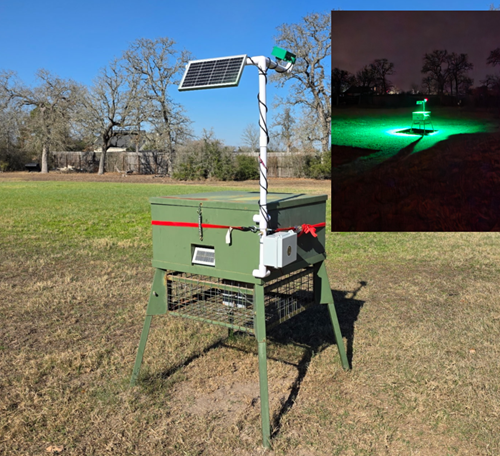
HOGFADER offers an optional solar-and-battery mounting kit for its Illuminator feeder light. The feeder motor and the light do not necessarily share the same power system. Here is how a typical solar feeder setup works.
A solar panel supplies charging current to a rechargeable battery, typically through a charge controller or other charging circuitry appropriate for the battery chemistry. Feeders often use 6V or 12V batteries, while accessory lights and cameras may require their own 12V battery or regulated supply. Confirm the voltage and wiring requirements of each device before connecting them.
A few core parts do the work:
- Photovoltaic panel: turns sunlight into DC power
- Charge controller: regulates charging; low-voltage disconnect protection is available on some controllers, but not all
- Rechargeable battery: stores energy for cloudy days and night use
- Timer and motor: control automatic dispensing
- Weatherproof housing: shields wiring from rain, dust, and rodents
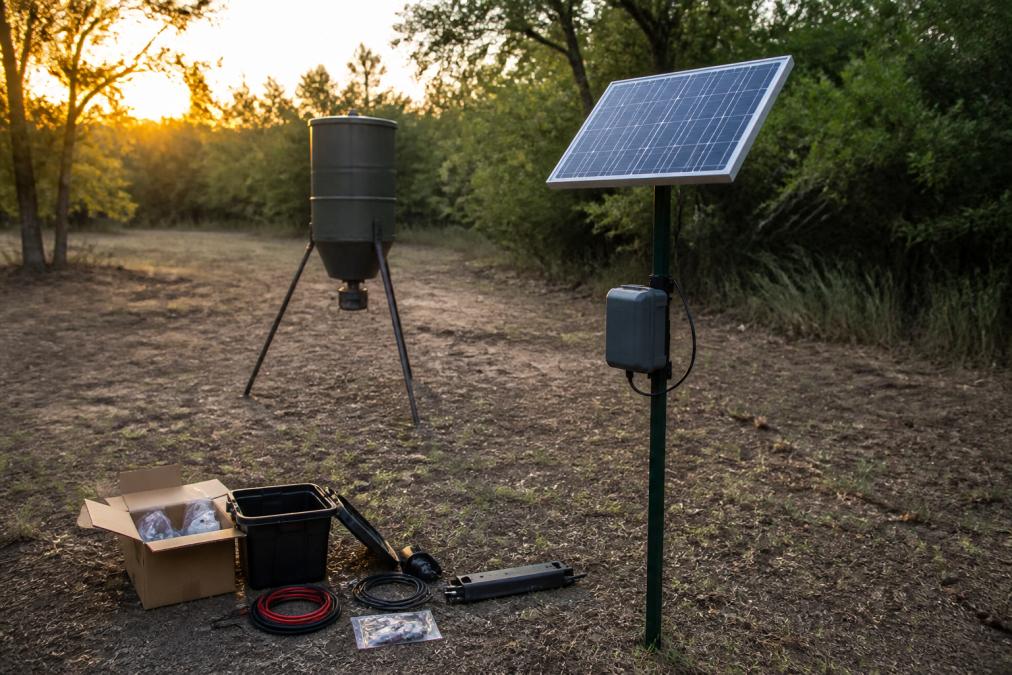
The whole system is a small stand-alone power system. No grid or generator is needed when the panel and battery are sized appropriately, although occasional inspection and battery replacement may still be necessary.
Panels, Controllers, and the Battery That Runs the Motor
The controller is the part most people overlook. An unsuitable or poorly configured controller can overcharge a battery. A compatible controller manages charging, and a low-voltage disconnect (if provided) can help prevent excessive discharge.
Battery type matters too. Lead-acid batteries are common and affordable. They handle trickle charging well but degrade over time. Match panel output and battery capacity to the actual load, expected sunlight, and battery chemistry.
Solar-Powered Feeder Light Benefits for Night Hunting and Feeding
A solar-powered feeder-light setup can reduce the need for manual battery charging. That matters most on remote pasture where running power is not an option.
The benefits stack up fast:
- Off-grid power that works where extension cords cannot reach
- Rechargeable power instead of buying disposables all season
- Wildlife monitoring and night visibility at the feeder
- Less frequent battery servicing when the charging system meets the nightly load
For hog hunters, light choice matters as much as power. HOGFADER builds its Illuminator around its No-Spook gradual illumination. Instead of switching immediately to full brightness when motion is detected, the light fades up over approximately 70 seconds, holds for about two minutes, and then fades down. This avoids the sudden burst of light that can startle animals.
The Illuminator is offered in red and green. For hunters using compatible night-vision equipment, HOGFADER also offers an 850nm infrared option in its Platinum product line. Infrared illumination is not visible in the same way as red or green light and requires an IR-sensitive viewing device.
Pro Tip
Infrared is not only for trail cameras. If you run an IR-sensitive night vision scope, an 850nm illuminator lets you actually see and shoot at the feeder, not just record it.
Infrared is not only for trail cameras. If you run an IR-sensitive night vision scope, an 850nm illuminator lets you actually see and shoot at the feeder, not just record it.
The Math: Solar vs. Standard Batteries Over a Season
The cost case for solar is not really about the panel, it is about what you stop buying. Standard batteries are consumables. A solar setup turns that consumable into a rechargeable asset that you top off every day the sun is out.
Here is the practical comparison:
| Factor | Standard Batteries | Solar Setup |
|---|---|---|
| Upfront cost | Low per pack | Higher once |
| Ongoing cost | Recurring | Lower with suitable upkeep |
| Trips to the field | Frequent | Less frequent, not eliminated |
| Remote suitability | Poor | Strong |
| Season longevity | Varies by load and battery | Possible with adequate sizing |
| Failure mode | Battery depletion | Low charging or battery failure |
| Best fit | Feeder behind the barn | Feeder a mile back |
Battery Cycle Life and Long-Term Degradation
This is the part most guides skip, and it is where solar actually earns its keep. A full charge-discharge cycle represents a battery cycle; partial discharges also contribute to wear. A lead-acid battery, the flooded, sealed, or AGM type commonly used on feeders, handles a limited number of cycles before its usable capacity drops. Deep-cycle designs tolerate more abuse than starting batteries, but none of them last forever.
- Deep discharge. Draining a lead-acid battery below roughly half its capacity, repeatedly, is the fastest way to shorten its life. A suitable low-voltage cutoff can help protect a lead-acid battery from excessive discharge.
- Heat. A battery baking in direct summer sun ages faster than one in shade. If you can shade the battery box without shading the panel, do it.
- Overcharging. A failed or cheap controller that never stops charging will cook the electrolyte. This is why the controller matters more than the panel wattage.
- Sulfation during storage. A battery left discharged through the off-season can sulfate and lose capacity permanently. Proper maintenance charging during storage can help reduce sulfation; a solar system can provide it when sunlight and charging equipment are adequate.
Key Takeaway
Choose a panel, controller, and battery as a matched system. The right equipment depends on battery chemistry, expected load, and available sunlight.
Choose a panel, controller, and battery as a matched system. The right equipment depends on battery chemistry, expected load, and available sunlight.
How to Monitor Remote Land Without Internet
Some cameras and monitoring systems work without cellular service by recording locally or offering a short-range Wi-Fi connection. Local Wi-Fi does not mean you can check the feeder remotely from home: you must be within the device’s Wi-Fi range. HOGFADER Platinum provides local Wi-Fi camera access without requiring cellular coverage.
Watch Out
Do not confuse IR night vision with thermal imaging. Thermal optics read heat and do not need an IR illuminator at all. If you run thermal, an IR light adds nothing.
Do not confuse IR night vision with thermal imaging. Thermal optics read heat and do not need an IR illuminator at all. If you run thermal, an IR light adds nothing.
Best Practices for Remote Feeder Maintenance
Remote feeder maintenance comes down to a short checklist you run before and during the season. Preventative maintenance beats emergency repairs every time, and on a feeder you cannot see from the house, it is the only kind of maintenance you get to do on your schedule.
- Check the panel for dust, mud, and wasp nests
- Confirm the controller shows a charge
- Test the timer and automatic dispensing
- Inspect wiring for rodent damage
- Clear brush that shades the panel
- Verify the mounting bracket is tight
- Wipe the light lens and camera window
- Keep the battery enclosure dry and follow the battery manufacturer’s ventilation requirements
Panel Orientation, Seasonal Sun Angles, and Charging Troubleshooting
Aim the panel south in most of the country for the strongest sun. Seasonal sun angles shift through the year, so a panel that charges well in June may lag in December. Tilt it to match the season when you can, steeper in winter, flatter in summer. In the northern half of the country, a winter tilt that faces the low southern sun can be the difference between a topped-off battery and a dead one in January.
Pro Tip
A cheap digital multimeter lives in your truck kit for a reason. Five minutes of testing at the feeder beats two trips to town guessing which part to replace.
A cheap digital multimeter lives in your truck kit for a reason. Five minutes of testing at the feeder beats two trips to town guessing which part to replace.
Key Takeaway
Shade, dirt, wiring, charging equipment, and battery condition are all worth checking. Follow the manufacturer’s testing procedure and measure voltage safely before replacing components.
Shade, dirt, wiring, charging equipment, and battery condition are all worth checking. Follow the manufacturer’s testing procedure and measure voltage safely before replacing components.
When Solar Power Is Worth It for Deer Feeders, and When It Is Not
Solar power is worth it when your feeder sits far from power and you want it running all season. It may offer less value when the feeder is easy to reach and battery charging is not an inconvenience.
Choose solar if:
- Your feeder is on a remote pasture
- You want off-grid power with fewer manual charging trips (batteries still age and eventually need replacement)
- You run lights or cameras that draw power at night
- You want fewer trips to the field
Skip solar if:
- The feeder is close to home or power
- Heavy tree cover blocks the sun all day
- You only run the feeder for a few weeks
Frequently Asked Questions
What size solar panel do I need for a deer feeder?
It depends on what the panel is powering. A feeder motor that runs briefly may use relatively little energy, but the appropriate panel size depends on the feeder’s voltage, daily energy use, charging losses, and local sunlight. Add a feeder light, camera, or timer mechanism that runs nightly and the draw climbs fast. Check the panel’s output against your total daily power consumption, and size up rather than down so short winter days still keep the battery charged.
Does a solar panel charge a deer feeder battery in cloudy weather?
Yes, but at a reduced rate. Panels still collect diffuse light on overcast days, so charging continues, just slower. The real risk is a stretch of heavy clouds combined with heavy nightly use, which can slowly drain the battery. A solar controller with voltage regulation prevents over-discharge, and sizing the panel and battery for reduced winter sunlight improves reliability during cloudy periods, though extended poor weather may still require manual charging.
How long does a battery last in a solar deer feeder?
Runtime depends on battery capacity and how much the feeder draws each night. A lead-acid battery running only a feeder motor may last days or weeks per charge, while adding a light or camera shortens that considerably. Battery cycle life matters more long term: repeated deep discharges wear out lead-acid batteries faster, so a properly sized panel and controller that keep the battery in a healthy charge range will extend its service life across multiple hunting seasons.
Is solar power reliable for remote feeder lighting systems?
It is reliable when the panel, controller, and battery are matched to the load and the local sun exposure. Remote setups fail most often from undersized panels, shaded mounting spots, or corroded connections, not from solar itself. For hog hunters, the HOGFADER Illuminator can be paired with its optional solar-and-battery mounting kit. Its No-Spook programming gradually increases illumination over approximately 70 seconds rather than switching abruptly to full brightness.
Managing hogs on remote land means your gear has to run without you. Solar power handles the energy side, but the light itself still decides whether hogs stick around. HOGFADER offers red and green Illuminator feeder lights with No-Spook gradual illumination and an optional solar-and-battery mounting kit. Its Platinum line adds a local Wi-Fi camera and includes an 850nm infrared variant for compatible night-vision equipment. Get started with Hogfader and keep your feeder running and your hogs calm all season.