
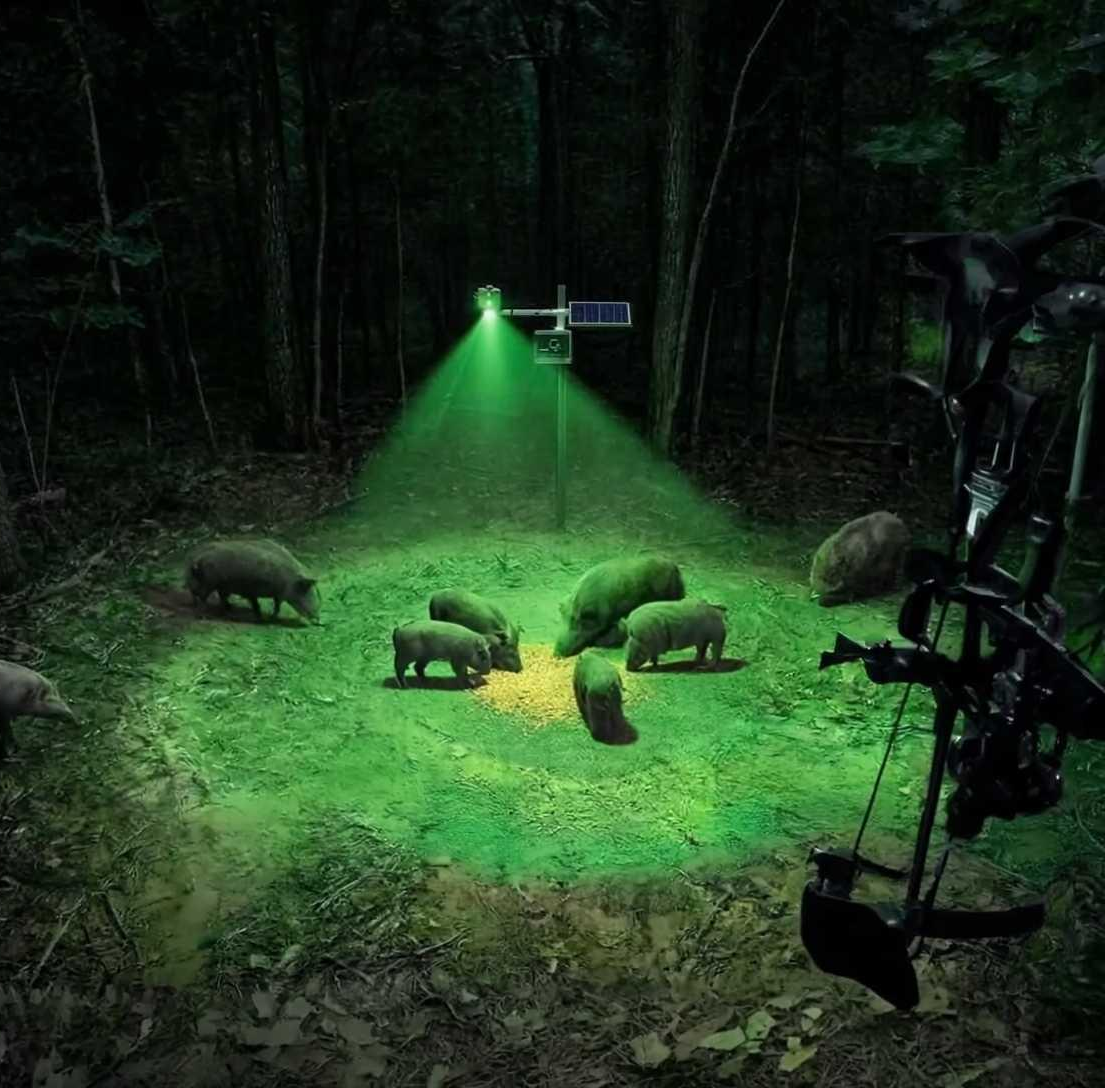
Why using Motion Activated Lights for Hog Hunting Works
Table of Contents
- Why Motion Activated Lights for Hog Hunting Beat Floodlights
- The Problem With Sudden, Full-Brightness Lights
- How Motion Activation Improves Battery Life and Consistency
- The No-Spook Illumination Concept Explained
- Green vs Red Light for Hogs: What Actually Matters
- Using 850nm Infrared for Hog Hunting
- How to Reduce Light-Related Spooking at Feeders
- Power, Weather, and Cold-Weather Performance
- Adding Camera Integration Without Cell Service
- Frequently Asked Questions
Updated: October 14, 2026
Why Motion Activated Lights for Hog Hunting Beat Floodlights
Motion activated lights for hog hunting solve a problem floodlights create: they only light up when something is actually there. A floodlight left running all night uses more energy and may change how animals respond to the feeder area. A motion-triggered light stays dark until it matters.
At Hogfader, we build feeder lighting around that principle. The light waits. When a hog steps in, illumination comes up slowly instead of slamming on. That gradual transition is designed to reduce the disturbance associated with sudden illumination.
The sections below cover how motion activation works, why gradual brightening matters, how green, red, and 850nm infrared differ, and how to mount and power a system so hogs keep coming back.
The Problem With Sudden, Full-Brightness Lights
A conventional floodlight or DIY motion light does one thing when it triggers: it goes straight to full output. That abrupt change may startle animals already feeding or approaching.
Feral swine are cautious by nature. They approach a bait site in stages, testing the air and watching for movement. A hard light snap interrupts that approach at the worst moment. Some hogs may leave temporarily, although responses vary with conditions and prior experience.
Constant-on floodlights cause a different problem. They keep the site illuminated throughout the night, whether or not animals are present. Plus, a light running dusk-to-dawn drains a battery fast at a remote site.
The fix is not a brighter light. It is a smarter trigger.
How Motion Activation Improves Battery Life and Consistency
Motion activation does two jobs at once. It saves power, and it keeps the site dark the rest of the time.
- Power savings: The light only draws full current when game is present. That stretches battery capacity across a season.
- Consistency: The site is not illuminated continuously; this may help limit unnecessary changes in the feeder environment.
- Longer field life: Less run time means fewer trips to swap or charge batteries at remote setups.
For solar-powered setups, this matters even more. A panel has to replace whatever the light uses. If the light runs all night, the panel may not keep up in winter. If it runs only on triggers, the math works in your favor.
The trade-off is sensor tuning. A poorly positioned PIR sensor can trigger on moving warm animals or changing heat patterns in its field of view. We cover that below.
The No-Spook Illumination Concept Explained
No-Spook illumination is a lighting approach where the light does not jump to full brightness on trigger. Instead, it ramps up gradually over approximately 70 seconds on the Hogfader Illuminator, giving hogs time to adjust as the scene brightens.
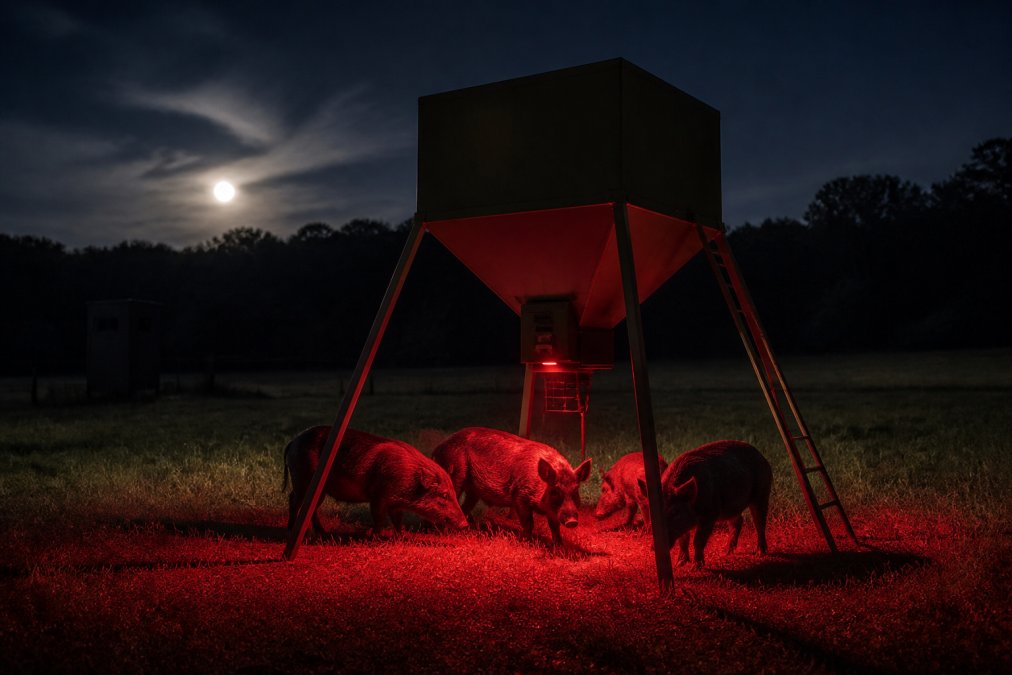
That gradual ramp is the core of how Hogfader feeder lights work. A conventional motion light goes from black to full in a fraction of a second. The Hogfader Illuminator ramps up over approximately 70 seconds rather than switching instantly to full brightness.
Key Takeaway
The No-Spook difference is not the sensor. It is the ramp. The Illuminator gradually brightens over approximately 70 seconds rather than switching on at full output.
The No-Spook difference is not the sensor. It is the ramp. The Illuminator gradually brightens over approximately 70 seconds rather than switching on at full output.
Green vs Red Light for Hogs: What Actually Matters
Both green and red are legitimate choices for hog hunting illumination. Neither is universally invisible to hogs, and neither is always better. The practical differences come down to how you hunt and what your optics handle.
- Green light: Often reads brighter to the human eye at the same output. Good for positive target ID and for shooters using standard optics.
- Red light: Lower on the visible spectrum. Many hunters find it less disruptive at close range, though hogs can still detect it.
- Your scope matters: Some night vision and hunting optics perform better with one color over the other. Match the light to your gear.
Using 850nm Infrared for Hog Hunting
850nm infrared illumination can be used with compatible IR-sensitive night-vision scopes and cameras. It is not a substitute for visible light when using a conventional optical scope. Hogfader Platinum is offered in an IR configuration for this purpose.
How to Reduce Light-Related Spooking at Feeders
Reducing light-related disturbances depends on mounting position, sensor placement, and how illumination changes when motion is detected. Feeder motors, noise, wind, and other activity can still startle hogs.
Mounting Height and Field of View
Mount the light above the feeder, angled down and out. A high mount spreads illumination across the bait site instead of hitting one spot. It also keeps the light out of the hogs’ direct line of sight.
- Aim for a downward angle that covers the feed area plus a few feet beyond.
- Keep the field of view wide enough to catch hogs approaching from multiple directions.
- Avoid pointing the light straight at the tree line where hogs stage before entering.
Sensor Placement and False Triggers
False triggers are the most common complaint with any motion light. A PIR sensor aimed at areas with moving warm animals, vehicles, or rapidly changing heat patterns may trigger unnecessarily and waste battery power.
- Point the PIR sensor at the bait site, not past it.
- Keep heat sources like engines or buildings out of the sensor’s cone.
- Keep the sensor clear of obstructions and avoid areas where sun-heated vegetation or other thermal backgrounds change rapidly.
- Test trigger sensitivity before you commit to a final mount.
Watch Out
Poor PIR placement can cause unnecessary activations and drain the battery. Aim the sensor toward the intended detection area and test it after mounting.
Poor PIR placement can cause unnecessary activations and drain the battery. Aim the sensor toward the intended detection area and test it after mounting.
Power, Weather, and Cold-Weather Performance
Power is where remote setups live or die. Solar-powered mounting options let you run a site without hauling batteries in and out, but winter changes the math in ways most feeder-light guides never explain.
Why Cold Weather Is the Real Test
Battery capacity drops as temperatures fall. The chemistry inside a battery slows down in the cold, so the same cell that runs a light all night in October may deliver noticeably less run time in January. That is true across battery types, but the practical effect shows up differently depending on how the light draws power.
- Trigger-only draw: A light that stays dark until motion triggers it pulls almost nothing between events. Cold still hurts, but the total demand is small enough that a charged battery can often carry the site through a cold snap.
- Constant-on draw: A floodlight running dusk-to-dawn pulls continuous current. In freezing temperatures, that is the fastest way to wake up to a dead site.
Solar in Winter: What Actually Fails
A solar-powered system may underperform when the panel receives insufficient sunlight, the battery loses capacity, or connections develop problems. Snow, ice, frost, and even heavy dust block the cells, and a shaded panel cannot recharge anything.
- Keep the panel angled so snow slides off rather than piling up.
- Clear ice and frost after storms, not just snow.
- Watch for tree growth or new brush that shades the panel as the season progresses.
- Remember that shorter winter days mean less charging time even on a clear panel.
Pro Tip
If you run solar in winter, keep the panel clear of snow and ice. Shade, debris, short winter days, and battery condition can all reduce solar system reliability.
If you run solar in winter, keep the panel clear of snow and ice. Shade, debris, short winter days, and battery condition can all reduce solar system reliability.
Weatherproofing and Housing
A feeder light sits outside year-round through rain, ice, dust, and temperature swings. Look for a sealed housing and a proper waterproof rating. A unit that is not sealed will eventually take on moisture, and moisture plus cold is what kills electronics.
Matching Power to Your Setup
The honest answer is that no single power configuration fits every property. A feeder close to the house with easy access to charging may not need solar at all. A feeder a mile back on a lease almost certainly does. Motion activation is the common thread: the less the light runs, the more forgiving every power decision becomes.
Adding Camera Integration Without Cell Service
Remote properties often have no cell signal and no internet. That used to mean no camera at the feeder. It does not anymore.
| Feature | Hogfader Illuminator | Hogfader Platinum |
|---|---|---|
| Illumination | No-Spook gradual ramp | No-Spook gradual ramp |
| Color options | Green and red | Green and red |
| Camera | None | Integrated Wi-Fi camera |
| Live viewing | No | Yes, local Wi-Fi |
| Cell service needed | No | No |
| Power | 12V battery; optional solar charging setup | 12V battery; optional solar charging setup |
Frequently Asked Questions
What are the downsides of using motion activated lights for hog hunting?
The main downside is setup sensitivity. A poorly aimed PIR sensor can trigger on moving branches, passing cattle, or heat sources, which wastes battery and can alert hogs. Cheap motion lights that jump straight to full brightness also defeat the purpose by spooking animals. HOGFADER addresses both issues with gradual No-Spook illumination and motion sensing designed for feeder use. Mounting height, angle, and field of view all affect how well any motion activated light performs.
What color light is best for hog hunting at night?
There is no single best color. Green and red are both legitimate choices, and 850nm infrared is an option for hunters using compatible IR-sensitive night-vision devices; it is not visible illumination for a standard optical scope. Red tends to preserve a hunter’s night vision and is less visible to some game, while green often reads brighter to the human eye at the same output. HOGFADER offers the Illuminator in red and green, with 850nm infrared available on compatible Platinum configurations for use with IR-sensitive night-vision equipment.
How can gradual illumination reduce light-related spooking?
Hogs react to sudden changes in their environment. A light that snaps from darkness to full brightness in under a second reads as a threat. HOGFADER’s No-Spook approach raises illumination gradually over approximately 70 seconds on the Hogfader Illuminator, so the change is slow enough that hogs at the feeder keep feeding instead of bolting. This design aims to reduce light-related disturbances without requiring a separate light-training period; animal behavior still varies.
Do I need cellular service for a feeder camera system?
Not with the HOGFADER Platinum. It uses a local Wi-Fi connection so a nearby hunter can view live video, take photos, record, and download media without cellular or internet service. That matters on remote ranches and properties where cell coverage is unreliable. If you hunt from a distance and need remote alerts, that is a different category of product. The Platinum is built for hunters positioned close enough to connect directly.