
Best Hog Feeder Light: 2026 Night Hunting Guide
Table of Contents
- What Makes the Best Hog Feeder Light
- Infrared vs Green Light for Hogs: Choosing Your Spectrum
- How No-Spook Feeder Light Technology Changes the Game
- Solar Powered Hog Lights for Remote Hunting Properties
- Wireless Feeder Camera Systems Without Cellular Service
- Installation, Mounting, and Setup Tips for Hog Feeder Lights
- Legal Compliance and Night Hunting Regulations by State
- Common Mistakes and Troubleshooting Your Hog Feeder Light
- Frequently Asked Questions
Last Updated: September 10, 2026
What Makes the Best Hog Feeder Light
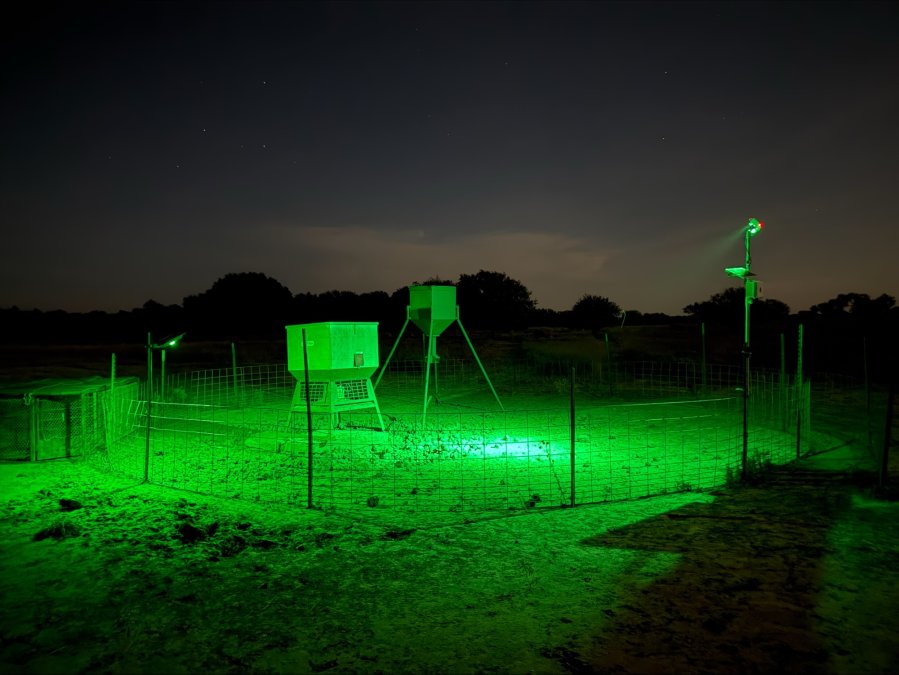
The best hog feeder light illuminates hogs already at the feeder without startling them, controlled brightness, not maximum brightness. Sudden full-power light is the most common reason hunters lose hogs at the feed station.
HOGFADER builds feeder lights around that problem. NO-SPOOK technology ramps illumination up gradually rather than snapping on at full output, so a sounder already on the feed doesn’t blow out of the field.
Most buyers shop for the brightest unit on the shelf. Lumens matter, but a light that hits full intensity in a fraction of a second works against you. You want one that comes on softly, builds over time, and holds steady on the feed area.
Four things separate a workable feeder light from a frustrating one:
- Controlled activation, gradual brightening instead of an instant blast
- Reliable motion sensing, trips on hogs, not every passing branch
- Real weather sealing, survives rain, dust, and temperature swings
- Mounting flexibility, feeder legs, T-posts, tree trunks, fence lines
Get those right and the rest is preference.
Infrared vs Green Light for Hogs: Choosing Your Spectrum
Most guides stop at “green is best.” That’s incomplete, green, red, and infrared behave differently in the field, and the answer comes down to how a hog’s eye is built versus yours.
How Hog Vision Differs From Human Vision
Hogs aren’t colorblind the way hunters assume, but their photopigment arrangement differs from ours: two cone types rather than three, so color discrimination is limited (PubMed). More importantly for feeder-light selection, hogs have a high proportion of rod cells and a reflective tapetum lucidum that boosts low-light sensitivity (PubMed). A hog sees better in the dark than you do and is more sensitive to sudden changes in illumination than to color.
That reshapes the spectrum debate. A feeder light rarely spooks hogs because of color, it’s the abrupt transition from dark to bright. A green light that snaps on at full power blows hogs out as fast as a white one.
What Each Spectrum Actually Does
- Green produces high perceived brightness to the human eye, which is why it dominates night-hunting discussions. It preserves detail at distance and works well for hunters glassing with the naked eye.
- Red is less disruptive to your own dark adaptation and produces a softer field of view, easier to sit behind for long stretches without losing night vision.
- 850nm infrared doesn’t illuminate the scene for your naked eye, but it is not a recording-only tool. HOGFADER offers 850nm IR illumination for hunters running IR-sensitive night vision scopes and other compatible night vision equipment. Both the HOGFADER Illuminator and the HOGFADER Platinum can be configured with 850nm IR.
Two clarifications. Thermal optics don’t need an IR illuminator at all, thermal imaging reads heat signatures, not reflected light. And 850nm IR is not completely invisible; an 850nm LED emitter can throw a faint red glow a sharp-eyed hog may pick up, especially at close range (PubMed).
Matching Spectrum to Optic
The right spectrum is the one your optic can use. Running an IR-sensitive night vision scope? 850nm IR is the match. Glassing with your naked eye? Green or red makes more sense, and the choice is largely about managing your own dark adaptation. Running thermal? You don’t need an illuminator at all.
Pro TipMatch your spectrum to your optic before you buy. A green light behind an IR-only scope does nothing useful, and an IR illuminator behind a naked-eye setup leaves you staring at a dark feeder.
The Variable That Matters More Than Color
Spectrum gets the headlines, but activation behavior determines whether hogs tolerate a light. A gradual ramp reads as ambient change; an instant snap to full brightness reads as a threat, regardless of emitter color. That’s the principle behind HOGFADER’s NO-SPOOK technology.
How No-Spook Feeder Light Technology Changes the Game
HOGFADER’s core advantage is slow, controlled brightening. Our light’s NO-SPOOK technology increases illumination gradually over 70 seconds instead of switching to full brightness instantly (red & green), giving hogs already moving toward the feeder time to adjust.
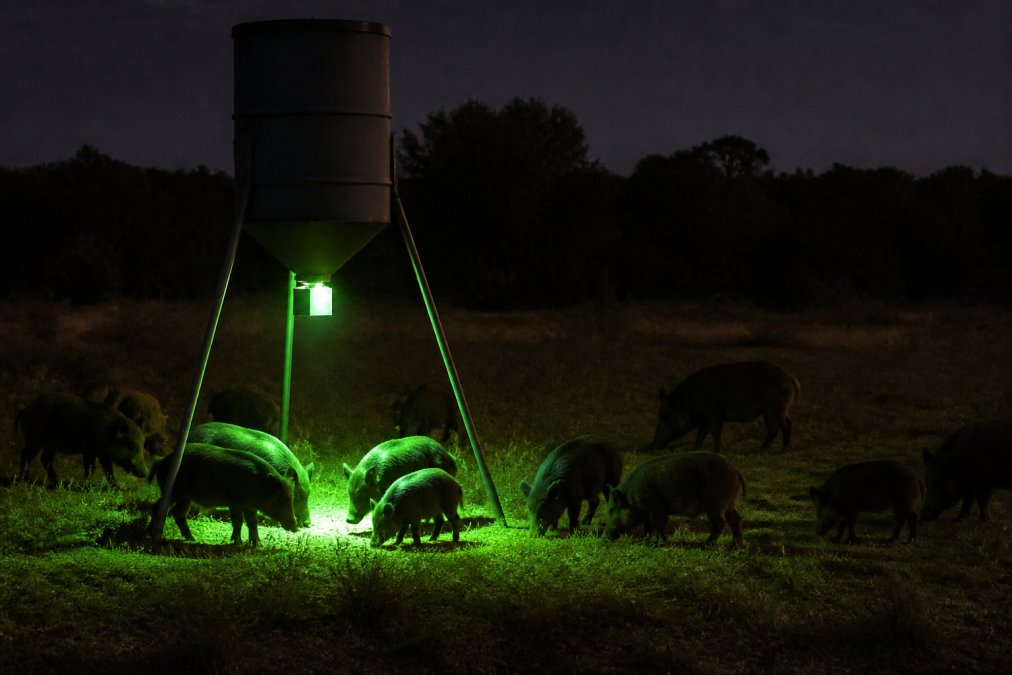
That gradual ramp is the point. Conventional feeder lights create a hard transition, dark, then blinding, which hogs associate with danger. A slow build reads as ambient change, far less alarming.
The Illuminator is motion-activated with automatic day/night operation, and it’s available in green, red, and 850nm infrared. Solar-powered mounting options are available for setups away from power.
On the “no training period” question: the design goal is that hogs don’t need a conditioning period to tolerate the light. That’s a function of how the light behaves, not a guarantee about every animal on every property.
Solar Powered Hog Lights for Remote Hunting Properties
Solar is the default answer for feeders far from an outlet, but “solar-powered” on a spec sheet doesn’t tell you whether the system will still run in February. What separates a solar feeder light that works from one that dies mid-season: the power budget, real-world sun exposure, and how the system handles bad weather.
HOGFADER offers optional solar-powered mounting systems, including a 10W panel option, designed for feeders in locations without convenient power access.
The Power Budget Is the Whole Game
A solar feeder light is a closed loop. The panel must replace, every day, whatever the light draws every night, plus a margin for cloudy days. If it can’t keep up, the battery walks down until the light stops tripping.
The variables that matter:
|
Factor |
Why It Matters |
What to Check |
|---|---|---|
|
Panel output |
Determines daily recharge |
Panel wattage vs. the light’s nightly draw |
|
Battery capacity |
Carries you through cloudy stretches |
Rated capacity and chemistry |
|
Nightly runtime |
Sets the daily draw |
How many hours the light is actually active |
|
Mounting angle |
Affects solar gain |
Adjustability for your latitude and season |
|
Weather sealing |
Panel and connectors fail first |
IP rating on housing and connectors |
The most common mistake is sizing the panel for a sunny July day and hunting in December. Shorter days, lower sun angles, and overcast weather cut solar gain exactly when many hunters run feeders hardest.
Seasonal Sun and Panel Placement
A panel rated at 10W produces 10W under ideal test conditions, not under a tree canopy in November. Real-world output depends on direct sun hours, panel angle, and daily shade.
Practical placement rules that hold up across most properties:
- Face the panel toward the sun’s arc for your latitude. A fixed panel should be tilted to catch the most direct sun across the seasons you actually hunt.
- Keep the panel out of shade for most of the day. Morning shade is less costly than afternoon shade in most of the country, but any sustained shade cuts the daily recharge.
- Watch for seasonal shade. A panel that’s clear in spring can be under a full canopy by fall. Deciduous trees are the most common cause of a solar light that worked fine in June and died in October.
- Keep cable runs short and protected. Long runs lose voltage and give livestock and wildlife more to chew on.
Watch OutMounting a solar panel in shade “because it’s out of the way” is the fastest way to a dead battery. The panel needs direct sun for most of the day, even if that means a longer, well-protected cable run to the light.
Battery Chemistry and Cold Weather
Battery performance drops in cold weather. A battery that carries a light through a mild fall may fall short on the first hard freeze. Sizing with margin, not to the bare minimum, keeps a feeder light running through the coldest weeks.
Maintenance That Keeps Solar Systems Alive
Solar feeder lights fail for predictable reasons, and most of them are preventable:
- Dust and pollen on the panel. A dirty panel produces less than a clean one. Wipe it down before the season and again mid-season.
- Corroded or loose connectors. Check the panel-to-light connection for moisture intrusion and tightness.
- Battery aging. Rechargeable batteries lose capacity over time. A system that ran all night in year one may not in year three.
- Panel drift. Wind and livestock move panels off angle. Re-aim after storms.
Key TakeawayA solar feeder light is a system, not a component. Size the panel and battery for your worst-case season, not your best-case day, and check the panel and connectors before every season.
Wireless Feeder Camera Systems Without Cellular Service
The HOGFADER Platinum combines feeder illumination with an integrated Wi-Fi camera, letting a nearby hunter connect directly by Wi-Fi to view the feed area. It streams live video, captures high-resolution photos, records video, and downloads media locally, no cellular service or internet connection required for that local Wi-Fi operation.
That matters for remote properties. Plenty of camera systems assume a cell signal at the feeder. On many hunting properties you don’t have one, and a camera that can’t reach a tower does nothing useful.
The Platinum is not a cellular trail camera. It’s a feeder-light system with a local Wi-Fi camera built in, so you can watch the feeder in real time from a nearby position and keep a record of what’s showing up.
For hunters who want to see the feed area without walking in and disturbing it, that local viewing is the practical benefit: check the screen, confirm what’s on the feed, decide whether to move.
Installation, Mounting, and Setup Tips for Hog Feeder Lights
Mounting flexibility makes a feeder light workable across different properties. HOGFADER lights offer mounting options for feeder legs, tree trunks, T-posts, fences, and tree branches, so you’re not locked into one configuration.
Practical setup guidance:
- Aim at the feed area, not the horizon. The light should illuminate the ground beneath the feeder where hogs actually stand.
- Keep the sensor clear of obstructions. Grass, hanging branches, and feeder hardware in front of the sensor cause false trips and dead batteries.
- Secure the mount against wind. A light that shifts angle after a storm is a light you’ll be re-aiming in the dark.
- Test before you hunt. Trip the light from where hogs approach and watch how the brightness ramps.
- Watch your cable runs. Route and protect any solar or power cabling from livestock and wildlife.
On tight properties where the “ideal” mounting position doesn’t exist, the answer is usually a different mount, not a different light. A T-post driven near the feeder often solves an angle problem that a tree mount can’t.
Legal Compliance and Night Hunting Regulations by State
Night hunting rules for feral hogs vary by state, and getting them wrong carries real consequences. Some states allow year-round night hunting with no permit; others restrict seasons, require a license, limit methods, or prohibit it on public land. A few require landowners to operate under depredation provisions.
Because the rules differ so much, treat this as a checklist rather than a fixed answer:
- Confirm whether your state allows night hunting of feral hogs at all
- Check whether a hunting license or permit is required
- Verify any restrictions on artificial light while hunting
- Check public-land vs. private-land rules separately
- Look for depredation or landowner provisions if you’re managing hogs on your own property
Your state wildlife agency’s website is the authoritative source, and it changes. Verify before the season, not after, artificial-light and night-hunting rules get updated without much fanfare.
Key TakeawayRegulations on night hunting and artificial light are state-specific and change. Confirm current rules with your state wildlife agency before every season rather than relying on what was legal last year.
Common Mistakes and Troubleshooting Your Hog Feeder Light
Most feeder light failures come down to setup, not hardware. Here’s what goes wrong and how to fix it.
|
Problem |
Likely Cause |
Fix |
|---|---|---|
|
Hogs bolt when light trips |
Instant full-brightness activation |
Switch to gradual-brightening technology |
|
Light trips constantly |
Sensor blocked by grass or branches |
Clear the sensor’s field of view |
|
Battery dies mid-season |
Undersized panel or shaded mount |
Reposition panel for full sun |
|
Light drifts off target |
Loose or wind-shifted mount |
Re-torque and add a locking mount |
|
No image at the feeder |
Assuming cellular coverage |
Use a local Wi-Fi camera system |
|
Foggy or hazy output |
Moisture in the housing |
Check seals and connections |
The biggest mistake is buying on brightness alone, a light that’s bright but abrupt spooks hogs every time. The second is mounting the panel or sensor without thinking about how the property works: where hogs approach, where the sun lands, and what will grow into the sensor’s path by mid-season.
Maintenance is simple but worth doing: clear the sensor and lens before the season, check seals, verify the panel is charging, and confirm your mount still holds zero. Ten minutes of prep beats a blown opportunity at last light.
Feral hogs don’t give you many clean opportunities, and a light that spooks them at the feeder wastes the ones you get. HOGFADER builds feeder lighting around that reality, with NO-SPOOK technology that ramps illumination gradually instead of blasting hogs with sudden brightness, available in green, red, and 850nm infrared, with solar-powered mounting options and the Platinum’s integrated local Wi-Fi camera for properties with no cell service. Get started with HOGFADER and keep hogs calm at the feeder for better shot opportunities.
Frequently Asked Questions
What color light is best for hog hunting?
Green and red are both effective choices for hog hunting. Green light preserves night vision well and provides clear target identification at distance, while red light is less noticeable to hogs in some situations. HOGFADER offers both options, along with 850nm infrared for use with night vision scopes. The best choice depends on your hunting setup and local regulations. Many hunters prefer green for general use and switch to infrared when running night vision equipment.
How does gradual illumination prevent spooking hogs?
Hogs are sensitive to sudden changes in their environment. When a conventional light snaps on at full brightness, it triggers a startle response and the sounder bolts. HOGFADER’s NO-SPOOK technology gradually increases illumination over approximately 60 to 90 seconds, mimicking natural light changes like dawn. This slow ramp gives hogs time to adjust without alarm, so they stay calm and continue approaching the feeder. No training period is required.
Do I need cellular service for a Wi-Fi enabled feeder camera?
No. The HOGFADER Platinum uses local Wi-Fi to connect directly to your phone or tablet, so it works in remote areas without cell towers or internet service. You can live stream, capture photos, and record video locally. This makes it practical for properties where cellular trail cameras fail. Just stay within Wi-Fi range of the unit, and you are ready to monitor your feeder day or night.
Are solar-powered feeder lights reliable for long-term night hunting?
Yes, when designed for outdoor use. HOGFADER offers solar-powered mounting options with a 10W panel that charges the battery during daylight. The motion-activated design means the light only draws power when hogs approach, extending battery life. For remote properties without easy access to power, solar is the most practical setup. Check the battery capacity and panel wattage to ensure it meets your hunting frequency.