
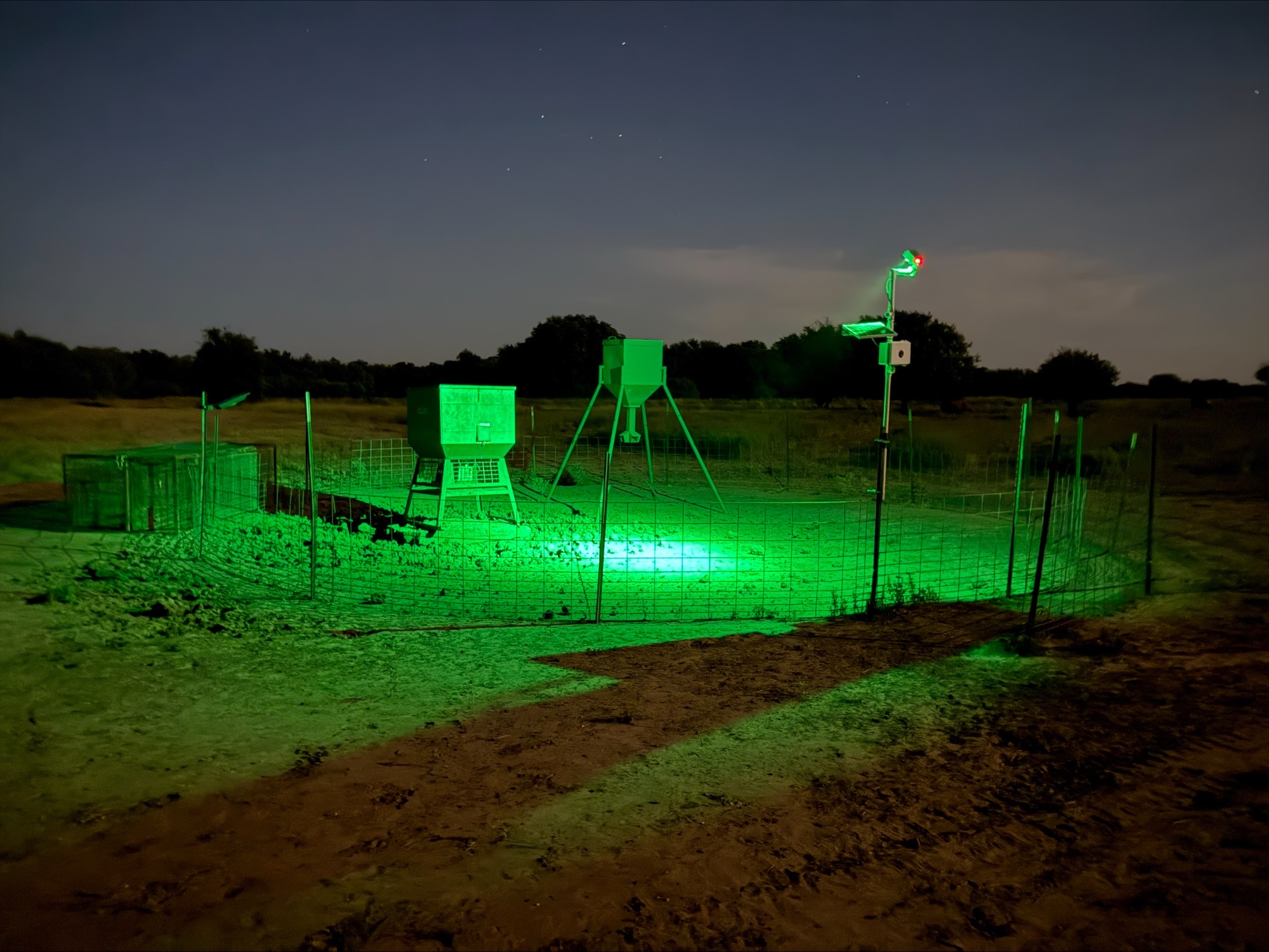
HOGFADER: From a Hunter’s Idea to Eight Years of Innovation
The story of HOGFADER and how firsthand observations of feral hog behavior inspired the development of an intelligent feeder light—and evolved into a Texas company specializing in nighttime hunting technology.
The HOGFADER Illuminator: Eight Years of Development
The story of HOGFADER began in Texas in 2018 with a problem familiar to many experienced nighttime hog hunters.
Feral hogs are intelligent, cautious animals. Larger, mature hogs can be especially reluctant to enter feeding areas when something about their surroundings makes them uncomfortable.
While hunting hogs at night, HOGFADER's founder repeatedly observed that larger animals often remained in the shadows rather than approaching a feeder that was already brightly illuminated.
The hogs were there. They were interested in the food. But the lighting conditions appeared to discourage them from moving into the open.
Conventional feeder lights could provide plenty of brightness, but that wasn't necessarily what the situation required.
The problem wasn't a lack of light.
The problem was when and how the light was introduced.
This observation led to a simple question:
"What if a feeder light allowed hogs to enter the feeding area before gradually illuminating it?"
That question became the foundation of HOGFADER.
2018: The Development of a Better Feeder Light
Dissatisfied with the feeder lights available at the time, HOGFADER's founder began developing his own lighting system in 2018.
His goal was to create a motion-activated light that would remain off until hogs entered the feeding area, then gradually increase in brightness rather than immediately switching to full intensity.
The concept was based on firsthand hunting experience rather than a desire to introduce another conventional lighting product.
The system needed to provide enough illumination for nighttime hunting while minimizing sudden changes that could alert cautious animals.
What initially appeared to be a relatively straightforward invention soon became a much larger undertaking.
Developing a reliable electronic lighting system required understanding LED technology, motion sensors, electronic circuits, microcontrollers, power management, and the behavior of the equipment under actual hunting conditions.
It would become an ongoing process of experimentation, testing, troubleshooting, and refinement.
Eight years later, that original idea has evolved into HOGFADER's specialized line of nighttime hunting equipment.
Learning Electronics Through Eight Years of Development
One of the most distinctive aspects of HOGFADER's history is the background of its founder.
He did not begin with formal training in electronics engineering or consumer product development.
His professional experience included extensive computer work and the design and three-dimensional modeling of large industrial structures.
That background provided a strong foundation in technical problem-solving, computer-based design, and understanding complex physical systems.
However, developing an electronic feeder light required learning an entirely different discipline.
Beginning in 2018, HOGFADER's founder undertook the process of learning electronics through hands-on development.
Over the following years, this work expanded to include electronic circuit design, microcontroller programming, LED driver technology, passive infrared motion detection, ambient-light sensing, battery monitoring, and wireless camera systems.
The learning process was driven by practical requirements.
When a sensor behaved unpredictably, the cause had to be identified.
When an electronic circuit produced unexpected results, the design had to be investigated.
When a component failed to perform as expected, alternatives had to be evaluated.
This approach gradually developed into the technical knowledge behind HOGFADER's products.
HOGFADER’s expertise was developed through years of actual design, experimentation, testing, and problem-solving.
The company's technology is the result of that experience.
The HOGFADER Illuminator: A Different Approach to Feeder Lighting
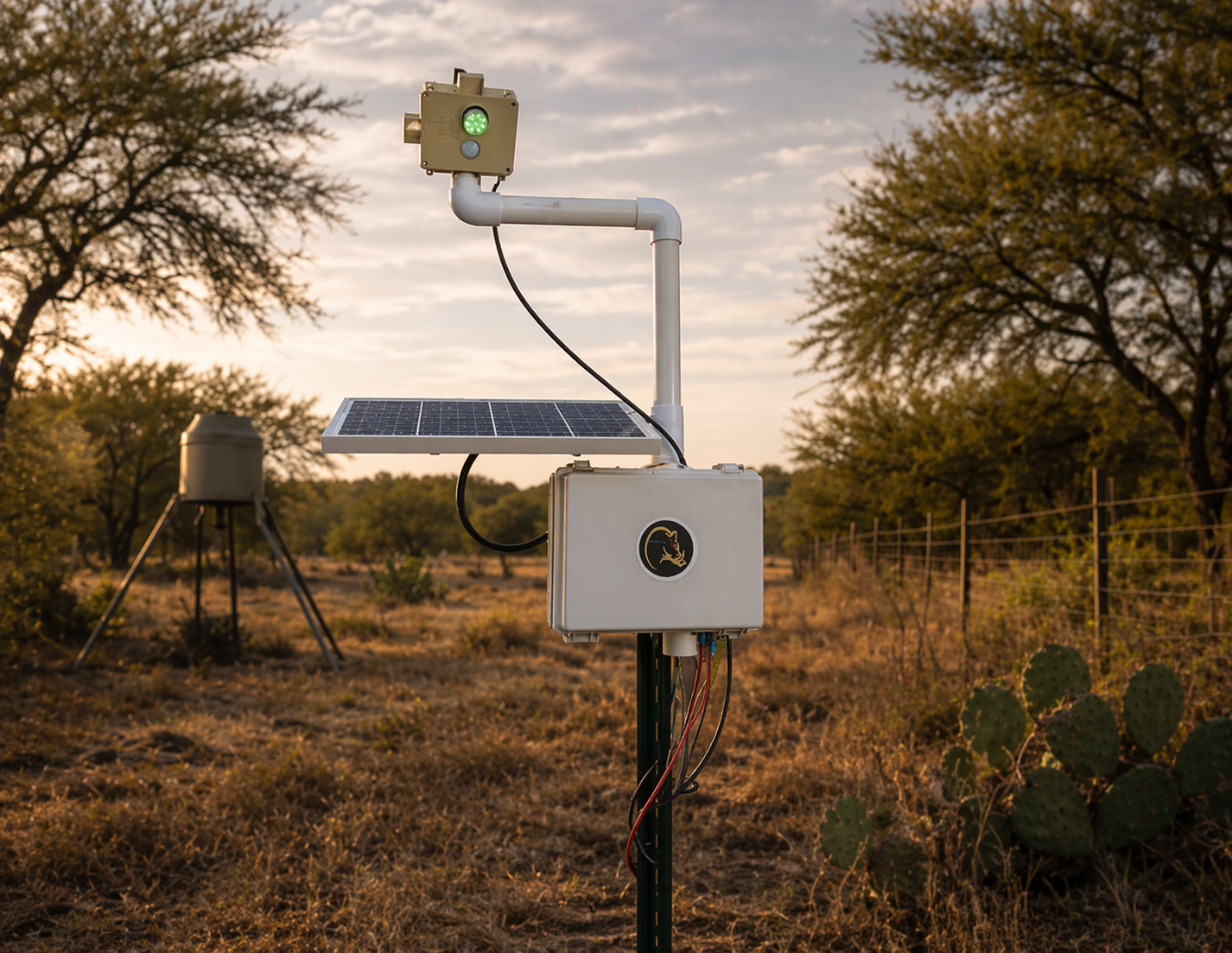
The HOGFADER Illuminator embodies the original idea that started the company.
Rather than functioning as a conventional motion-activated light that immediately switches to full brightness, the Illuminator uses a programmable electronic controller to manage the entire lighting sequence.
Its signature feature is HOGFADER's <strong>NO SPOOK gradual illumination technology</strong>.
When the system detects movement under appropriate nighttime conditions, it begins a controlled increase in LED brightness.
The light gradually reaches its operating intensity over approximately 70 seconds.
It then maintains illumination for approximately two minutes, with the ability to extend the lighting period when additional activity is detected.
At the conclusion of the cycle, the light gradually dims rather than abruptly switching off.
This sequence was developed to address the original problem observed in 2018: mature hogs remaining outside an already illuminated feeding area.
The objective is to allow animals to enter the area before full illumination is introduced.
Why Gradual Illumination Matters
A sudden change from darkness to bright light represents a noticeable environmental event.
Although feral hogs rely heavily on their senses of smell and hearing, they also respond to movement and changes in their surroundings.
The HOGFADER approach recognizes that illumination should be introduced thoughtfully.
Instead of assuming that hogs cannot detect certain colors, the Illuminator focuses on controlling the timing and intensity of the light.
The NO SPOOK system is designed to reduce abrupt lighting transitions that might disturb animals.
This does not mean every hog will respond identically. Animal behavior varies according to previous experiences, environmental conditions, and individual temperament.
However, the system directly addresses a practical problem identified through firsthand hunting experience.
Engineering the Illuminator's Electronic Control System
Behind the Illuminator's gradual lighting sequence is a purpose-built electronic control system.
The controller uses a programmable ATtiny85 microcontroller to coordinate motion detection, LED brightness, operating time, and other functions.
Unlike a basic on/off motion light, the Illuminator requires its electronic components to work together through a carefully programmed sequence.
The development process has involved several important technologies.
Microcontroller Programming
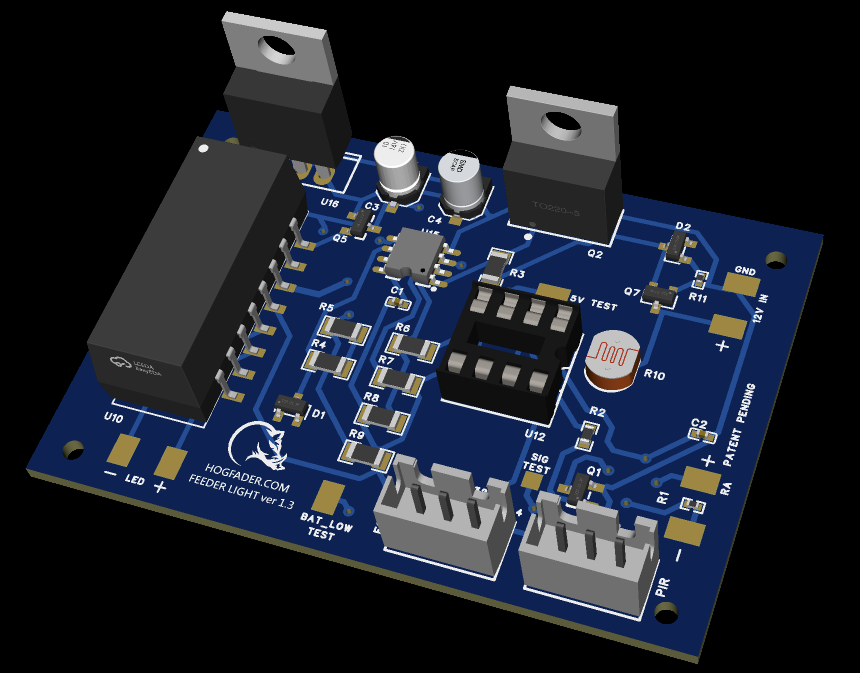
The Illuminator uses software to control the rate at which the LEDs increase and decrease in brightness.
Pulse-width modulation allows the controller to regulate apparent LED brightness through a sequence of precisely timed changes.
This provides greater flexibility than a simple mechanical switch or conventional motion-light circuit.
Passive Infrared Motion Detection
The Illuminator incorporates passive infrared sensing to detect activity near the feeder.
Motion sensor performance depends on proper placement, stable electrical signals, and suitable operating conditions.
HOGFADER's development work has included addressing electrical interference, sensor signal stability, and reliable communication between the motion detector and the microcontroller.
Ambient-Light Detection
The controller incorporates ambient-light detection to distinguish between daytime and nighttime conditions.
This allows the normal lighting sequence to operate when illumination is needed rather than unnecessarily activating during daylight.
Battery Voltage Monitoring
Remote feeder installations commonly depend on 12-volt batteries, often supported by solar charging systems.
Battery condition is therefore an important consideration.
The Illuminator incorporates low-voltage monitoring to help identify potentially inadequate battery conditions.
A battery may display a seemingly acceptable voltage while still being unable to maintain that voltage under load.
Understanding these electrical characteristics is essential when troubleshooting remote lighting equipment.
LED Driver Technology
High-power LEDs require appropriate current regulation to operate efficiently and reliably.
HOGFADER's Illuminator uses dedicated LED driver circuitry rather than relying on uncontrolled current delivery.
The relationship between LED current, brightness, power consumption, and heat generation is an important part of the overall design.
Together, these technologies make the Illuminator a programmable lighting system rather than simply an LED attached to a motion detector.
Understanding Feral Hog Behavior at Night
The development of HOGFADER has been closely connected to understanding how feral hogs behave around feeding locations.
Feral hogs are highly adaptable animals.
Their activity patterns can change in response to hunting pressure, human activity, food availability, weather, and environmental conditions.
In areas where hogs experience significant hunting pressure, nighttime activity may become particularly important.
Mature animals can also exhibit cautious behavior around unfamiliar conditions.
Why Larger Hogs May Remain in the Shadows
One of the observations that inspired HOGFADER was the tendency of larger hogs to remain outside brightly illuminated feeder areas.
This behavior can be influenced by multiple factors, including prior experiences and perceived disturbances.
A feeder light that remains continuously illuminated may provide excellent visibility while still creating conditions that some animals are reluctant to enter.
HOGFADER's approach was developed specifically to address that situation.
By allowing hogs to approach before gradually introducing illumination, the system attempts to provide hunters with a more favorable opportunity to observe animals already present near the feeder.
The Importance of Consistency
Hogs can become familiar with repeated conditions around feeding locations.
Consistent feeder schedules, predictable surroundings, and minimizing unnecessary disturbances may all contribute to successful nighttime hunting.
The Illuminator's gradual lighting sequence reflects this principle.
Rather than introducing an abrupt environmental change, it provides a controlled transition.
Red, Green, and Infrared Hog Hunting Lights
Selecting the appropriate lighting technology is another important part of nighttime hog hunting.
HOGFADER has developed Illuminator configurations using red, green, and infrared LEDs.
Each serves a different purpose.
Red LED Hog Hunting Lights
Red illumination is commonly used for nighttime wildlife observation and hunting.

It provides visible light while producing a different visual environment from conventional white lighting.
Some hunters prefer red illumination when attempting to minimize the conspicuousness of their lighting equipment.
However, red light should not be considered completely invisible to feral hogs.
Animal responses can vary according to light intensity, previous experiences, and environmental conditions.
HOGFADER's gradual illumination technology provides an additional approach to minimizing abrupt changes regardless of the selected visible-light color.
Green LED Hog Hunting Lights
Green illumination provides strong visual contrast for human observers and can be effective for identifying animals around a feeder.
HOGFADER's green LED configurations are designed to provide useful illumination over the feeding area.
The combination of LED output, beam angle, and mounting position determines how effectively the available light reaches the intended area.
Infrared Hog Hunting Lights

Infrared illumination serves a different purpose from visible red or green light.
HOGFADER's infrared configuration uses 850-nanometer LED technology intended for compatible night-vision equipment.
Infrared light at this wavelength is outside the normal range of human vision, although some 850-nanometer emitters may produce a faint visible red glow.
Infrared performance depends on the sensitivity of the imaging equipment, the optical configuration, and environmental conditions.
For hunters using compatible night-vision devices, infrared illumination can provide a useful alternative to visible lighting.
Why Beam Angle and Optical Design Matter
A feeder light's effectiveness cannot be measured by brightness alone.
The distribution of that brightness is equally important.
A narrow beam concentrates light into a smaller area, potentially increasing intensity at greater distances.
A wider beam distributes light across a larger area but generally provides less concentrated illumination.
HOGFADER's product development has included evaluating different LED lenses and beam angles to achieve practical coverage for feeder applications.
The company has worked with optical configurations ranging from relatively narrow beams to wider patterns intended to illuminate larger feeding areas.
Mounting height, distance, and the dimensions of the feeder location all affect the resulting illumination.
This is why effective feeder lighting requires attention to optical design rather than simply selecting the highest-output LED available.
Designed for Real-World Hunting Conditions
Electronic equipment used at remote feeder locations faces challenges that may not be apparent during laboratory testing.
Power availability can fluctuate.
Batteries can deteriorate.
Solar charging performance can change with weather conditions.
Motion sensors must respond reliably to activity.
Electrical connections must remain secure.
HOGFADER's development work has addressed these practical considerations through extensive testing and troubleshooting.
The Illuminator is designed for compatible 12-volt battery systems commonly used with hunting feeders.
Power consumption, electronic stability, and battery monitoring are important parts of its design.
The company's experience has also reinforced the importance of proper installation and maintenance.
A dependable feeder lighting system requires more than a well-designed electronic controller. It also depends on a healthy power source, appropriate wiring, correct positioning, and suitable environmental conditions.
Mounting Flexibility: An Important Part of the Design

No two feeder installations are exactly alike.
Hunters use different feeder designs, support structures, posts, and mounting arrangements.
A lighting system must accommodate these differences while allowing the beam to be directed toward the intended feeding area.
HOGFADER has devoted considerable attention to mounting flexibility.
The Illuminator's mounting options are designed to help hunters position the light for effective coverage.
Customer feedback has repeatedly highlighted the usefulness of this flexibility.
Mounting height and direction can significantly influence the amount of usable illumination reaching the ground.
Proper positioning helps hunters take full advantage of the light's capabilities.
The Next Evolution: HOGFADER Platinum
As HOGFADER's electronic development experience expanded, the company began exploring additional capabilities beyond conventional feeder lighting.
This work led to the development of the HOGFADER Platinum.
The Platinum builds on the Illuminator concept by integrating Wi-Fi camera technology with the feeder lighting system.
The objective is to provide hunters with a way to observe feeder activity through a connected device.
Developing this capability required extensive work with digital imaging, wireless communications, microcontrollers, and camera optics.
ESP32-S3 Camera Technology
The Platinum development program uses ESP32-S3 microcontroller technology.
These devices provide processing and wireless communication capabilities suitable for compact camera applications.
HOGFADER has evaluated several camera sensor configurations, including the OV2640, OV3660, and OV5640.
The development process has involved testing image quality, operating stability, resolution, camera settings, and power requirements.
Camera Lens Development
One of the challenges encountered during Platinum development has been selecting an appropriate camera field of view.
Wide-angle lenses can capture large areas, but animals at greater distances may appear too small for useful observation.
Narrower fields of view can provide a more concentrated image of the intended feeding location.
HOGFADER has investigated alternative lens configurations to improve the relationship between viewing distance and image detail.
This work illustrates the company's approach to product development: evaluating actual performance and making improvements when testing identifies an opportunity.
Wi-Fi Range and Antenna Performance
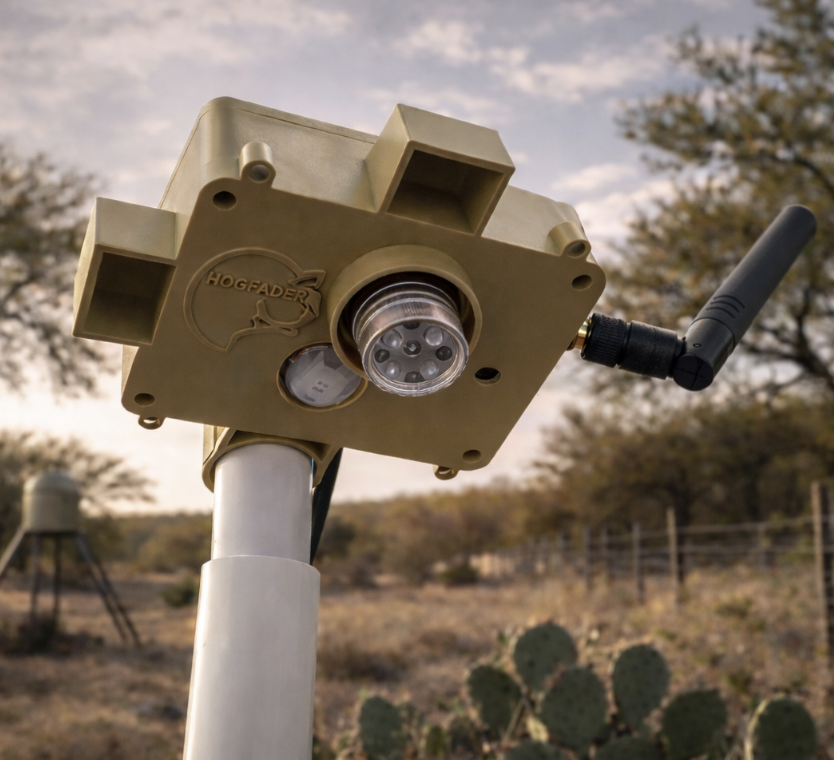
Wireless range is particularly important when a camera is installed at a feeder some distance from the hunter.
HOGFADER's development work has included evaluating external antennas, antenna placement, transmission power, and environmental interference.
Field testing has demonstrated connections approaching 150 yards under certain conditions, with additional development directed toward improving practical range.
Wireless performance depends on terrain, vegetation, obstructions, antenna orientation, and the capabilities of the connected device.
These factors must be considered when evaluating real-world operation.
Camera Controls and Recording
The Platinum camera interface has been developed to provide practical functions for observing feeder activity.
Development features include live video streaming, still-image capture, video recording, image orientation controls, and wireless signal information.
The objective is to provide convenient access to camera functions without unnecessarily complicating operation.
The Platinum represents an important expansion of HOGFADER's original concept.
It combines intelligent feeder illumination with electronic observation capabilities.
Continued Innovation in Wildlife Monitoring
HOGFADER's technical development has also extended into autonomous camera systems.
These projects have explored motion-triggered photography, video recording, removable storage, automatic day/night operation, and battery-powered electronics.
The work involves integrating digital camera sensors, motion detectors, microcontrollers, and storage systems.
Although these projects are distinct from the Illuminator, they contribute to HOGFADER's broader technical knowledge.
Experience gained from developing one electronic system can provide valuable insight when designing another.
Wireless reliability, sensor performance, electrical noise, power management, and camera operation are challenges shared across multiple products.
This ongoing experimentation supports HOGFADER's commitment to continuous improvement.
Customer Feedback and Product Refinement
One of the most important sources of information for any product developer is feedback from people using the equipment under real-world conditions.
HOGFADER customers have reported positive experiences with the Illuminator's brightness, coverage, and mounting flexibility.
Customer conversations have also provided opportunities to investigate installation issues, battery problems, and operating questions.
These experiences reinforce the importance of understanding the entire system rather than focusing on individual components.
For example, a light that fails to operate correctly may be affected by battery condition, electrical connections, sensor behavior, or controller settings.
Identifying the actual cause requires a systematic understanding of how the components interact.
HOGFADER uses this practical knowledge to support customers and guide continued product refinement.
A Texas Company Built on Experience and Persistence
Since beginning development in 2018, HOGFADER has grown from a personal invention into a specialized business focused on nighttime hog hunting technology.
Its foundation is unusual.
The company did not begin with a large engineering department or an established consumer electronics product line.
It began with a hunter who recognized a problem, believed there was a better solution, and committed himself to learning the skills necessary to develop it.
Over eight years, that effort has involved learning electronics, designing circuits, programming microcontrollers, testing optical systems, developing camera technology, and refining products based on practical experience.
The result is a company whose products reflect firsthand knowledge of the problems they are intended to solve.
HOGFADER's development philosophy remains rooted in the same principle that inspired its first light:
Understand the problem first. Then develop technology that solves it.
The Future of HOGFADER
HOGFADER continues to explore improvements in feeder lighting, wireless camera technology, and electronic wildlife monitoring.
Future development will remain focused on practical functionality, dependable operation, and features that provide genuine value to hunters.
The Illuminator and Platinum represent different stages of the same ongoing effort.
One began with the need to illuminate a feeder without abruptly disturbing cautious hogs.
The other expands that concept by incorporating wireless observation technology.
Both reflect the company's commitment to solving practical nighttime hunting problems through thoughtful electronic design.
More Than Just Another Feeder Light
After eight years of development, HOGFADER's original philosophy remains unchanged.
A better feeder light is not necessarily the brightest light or the one with the most features.
It is the light that performs the intended job effectively.
For HOGFADER, that means understanding the behavior of feral hogs, recognizing the limitations of conventional lighting, and developing equipment specifically for the conditions hunters encounter.
From the original NO SPOOK gradual illumination concept to advanced camera-equipped systems, HOGFADER continues to combine firsthand hunting experience with practical electronic innovation.
HOGFADER was born from a problem observed in the field, developed through years of hands-on experimentation, and continues to evolve through a commitment to better nighttime hunting technology.
About HOGFADER LLC
HOGFADER LLC is a Texas-based company specializing in the development of intelligent feeder lighting and camera technology for nighttime feral hog hunting.
Development began in 2018 with the invention of a gradual-illumination feeder light designed to address the behavior of cautious hogs approaching illuminated feeding areas.
Its products include the HOGFADER Illuminator, featuring NO SPOOK gradual illumination technology, and the HOGFADER Platinum, incorporating Wi-Fi camera capabilities.
HOGFADER continues to develop and refine its technology through electronic engineering, field testing, and customer feedback.
Leave a comment