
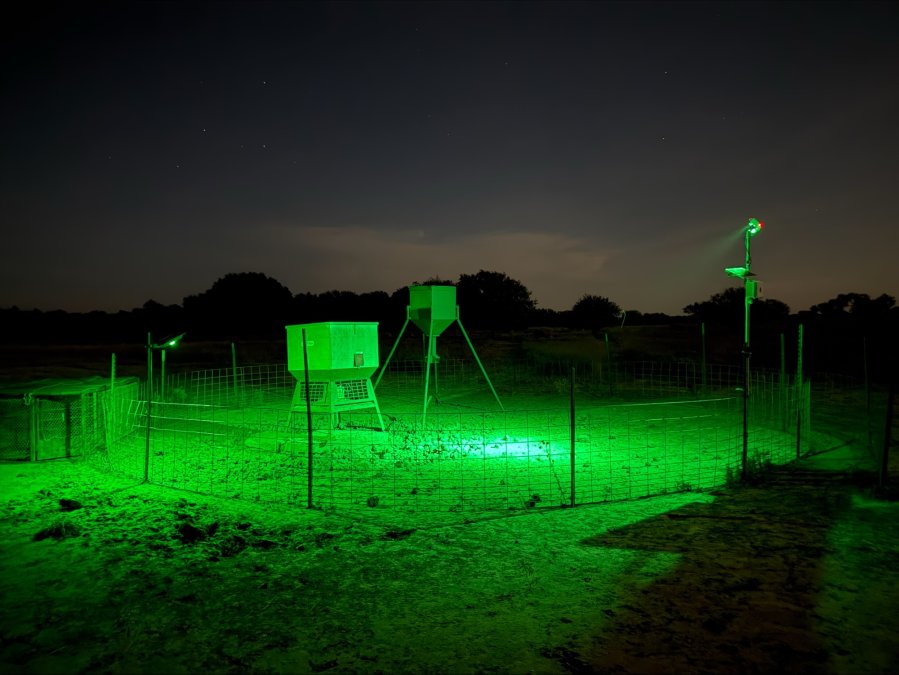
Hog Feeder Lights: HOGFADER Night Hunting Guide
Table of Contents
- What Makes the Best Hog Feeder Light
- Infrared vs Green Light for Hogs: Choosing Your Spectrum
- How No-Spook Feeder Light Technology Changes the Game
- Solar Powered Hog Lights for Remote Hunting Properties
- Wireless Feeder Camera Systems Without Cellular Service
- Installation, Mounting, and Setup Tips for Hog Feeder Lights
- Legal Compliance and Night Hunting Regulations by State
- Common Mistakes and Troubleshooting Your Hog Feeder Light
- Frequently Asked Questions
Last Updated: October 13, 2026
What Makes the Best Hog Feeder Light
The best hog feeder light fits your optic, covers the feed area, and offers dependable power and controlled activation. Brightness matters, but so do the way the light changes intensity and where you aim it.
HOGFADER builds feeder lights around gradual illumination. The HOGFADER Illuminator provides feeder illumination; the HOGFADER Platinum adds an integrated local Wi-Fi camera. Red and green versions use NO-SPOOK gradual brightening, designed to reduce abrupt changes at the feeder.
Compare usable illumination through your actual optic, rather than shopping on brightness alone. Aim for enough light to identify the animal and surroundings clearly, with a beam directed at the feed area.
Four things separate a workable feeder light from a frustrating one:
- Controlled activation, gradual brightening instead of an instant blast
- Reliable motion sensing, covers the approach area with minimal unwanted activation
- Real weather sealing, is rated for the conditions at your installation
- Mounting flexibility, feeder legs, T-posts, tree trunks, fence lines
Choose the spectrum, power system, and camera features around how you hunt.
Infrared vs Green Light for Hogs: Choosing Your Spectrum
Green, red, and infrared serve different viewing setups. Start with your optic and the visibility you need, rather than assuming one color is best for every hunter.
How Hog Vision Differs From Human Vision
Domestic pig retina research identifies two cone types sensitive to different wavelength ranges (Hendrickson and Hicks, 2002, PubMed). That finding describes retinal anatomy; it does not establish that feral hogs cannot see red or green light, or predict their response to a feeder light. Claims about color visibility and field behavior need more than a cone-count study.
Do not assume a colored light is invisible to hogs. Evaluate the whole setup: beam direction, intensity, activation, your movement, and conditions at the feeder. No color guarantees that animals will remain at the feed.
What Each Spectrum Actually Does
- Green provides visible illumination for unaided viewing and compatible conventional optics. Check usable detail at your hunting distance; green light does not preserve dark adaptation at every brightness.
- Red provides another visible-light option. Use only the intensity you need and test target detail through your optic. Do not assume red is invisible to hogs or that bright red light leaves your dark adaptation unaffected.
- 850nm infrared illuminates the scene for IR-sensitive night vision equipment, rather than unaided eyes. Both the Illuminator and Platinum offer an 850nm IR option. Check your optic’s wavelength compatibility; thermal optics do not use this illumination to form their image.
Thermal optics detect emitted thermal radiation and do not require an 850nm illuminator. Infrared illumination does not make a feeder visible to your unaided eyes; confirm that your night vision equipment is sensitive to 850nm before buying.
Matching Spectrum to Optic
For an IR-sensitive night vision scope, choose compatible 850nm IR illumination. For unaided viewing or a conventional daylight scope used with artificial light, choose visible red or green and verify that you can identify the target clearly. Thermal needs no feeder light to form its image, although a light may still serve a separate camera or visible viewing setup.
Pro TipMatch your spectrum to your optic before you buy. Check the optic manufacturer’s illumination requirements. Some night vision devices can use visible light as well as IR, while 850nm IR alone will not let you see the feeder with unaided eyes.
Considering Activation Alongside Color
Activation deserves attention alongside color. Red and green HOGFADER lights transition gradually from dim standby to brighter illumination. That is a product feature designed to avoid an abrupt brightness change, not proof that a hog will interpret the change as natural or stay calm.
How No-Spook Feeder Light Technology Changes the Game
HOGFADER’s NO-SPOOK feature brings red and green illumination up gradually over 70 seconds, rather than switching immediately to full brightness. The 850nm IR version changes intensity when motion is detected for power conservation; it does not use the red/green gradual fade.
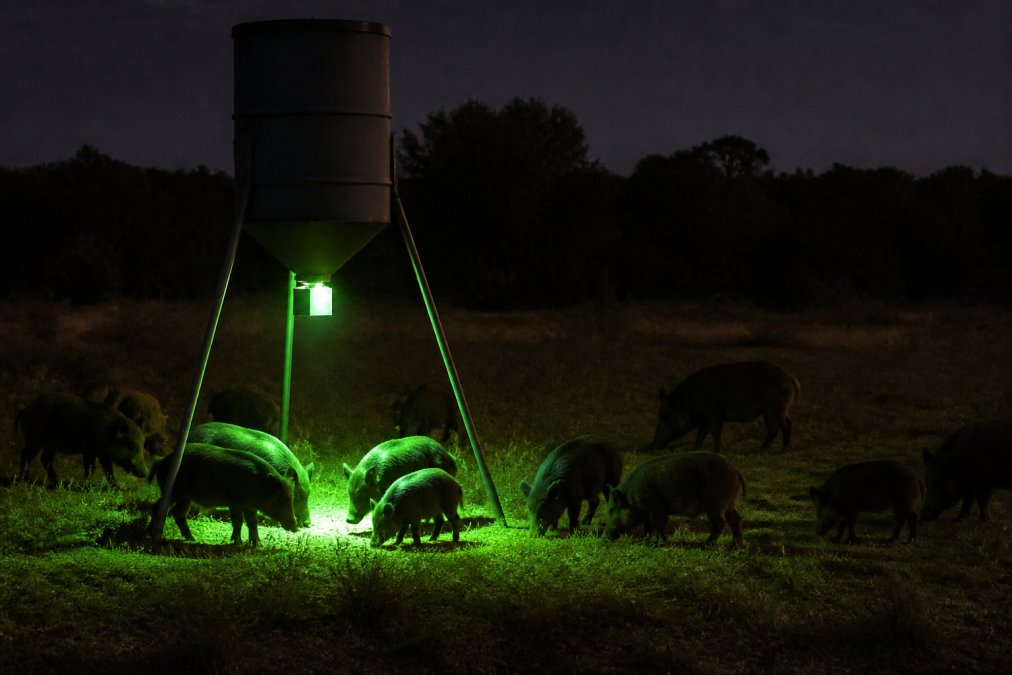
The gradual ramp is the distinction to look for when comparing visible feeder lights. Animal responses vary, so treat the feature as part of your setup rather than a guarantee against spooking.
The Illuminator feeder light uses motion activation and day/night operation, with red, green, and 850nm IR options. Optional mounting and solar charging equipment can support installations away from an outlet. Check the selected package for included parts and battery requirements.
HOGFADER is designed for use without a prescribed conditioning period. Install it, test operation, and observe activity at your feeder; that design intent does not guarantee immediate acceptance by every animal.
Solar Powered Hog Lights for Remote Hunting Properties
Solar charging can be useful at feeders far from an outlet. Reliability depends on the battery, actual energy use, available sunlight, and compatible charging equipment, especially during cloudy periods.
HOGFADER offers optional mounting equipment with solar charging. Compare the current options on the Illuminator product page or Platinum product page; confirm what is included and which battery and charging components are required for your selected setup.
The Power Budget Is the Whole Game
A solar charging system must replace the energy the equipment uses over time, while the battery provides a reserve between charging periods. Include dim standby operation, sensing and control electronics, brighter activation periods, and camera operation where applicable. Motion activation does not mean zero power use between triggers.
The variables that matter:
|
Factor |
Why It Matters |
What to Check |
|---|---|---|
|
Panel output |
Determines daily recharge |
Panel wattage vs. the light’s nightly draw |
|
Battery capacity |
Carries you through cloudy stretches |
Rated capacity and chemistry |
|
Nightly runtime |
Sets the daily draw |
Standby draw, brighter runtime, and camera use |
|
Mounting angle |
Affects solar gain |
Adjustability for your latitude and season |
|
Weather sealing |
Moisture can affect electrical connections |
Published outdoor-use specifications and connector protection |
Plan for the season you hunt. Shorter days, lower sun angles, and cloudy weather can reduce daily charging, so a setup that works in summer may need attention in winter.
Seasonal Sun and Panel Placement
A panel’s rated wattage is measured under specified test conditions. Actual charging depends on sunlight, shading, orientation, temperature, and the rest of the charging system; panel wattage alone does not establish runtime.
Practical placement rules that hold up across most properties:
- Face the panel toward the sun’s arc for your latitude. A fixed panel should be tilted to catch the most direct sun across the seasons you actually hunt.
- Keep the panel out of shade for most of the day. Assess shade across the whole day; sustained shading reduces charging.
- Watch for seasonal shade. Check shade during the season you hunt, including foliage growth and the changing sun angle.
- Keep cable runs short and protected. Long runs lose voltage and give livestock and wildlife more to chew on.
Watch OutA convenient but shaded mounting position can leave the battery undercharged. The panel needs direct sun for most of the day, even if that means a longer, well-protected cable run to the light.
Battery Chemistry and Cold Weather
Temperature affects usable battery capacity and charging. Follow the selected battery and controller specifications, including operating temperatures and any low-temperature charging limits. Use compatible components and allow capacity for periods of reduced solar charging.
Maintenance That Keeps Solar Systems Alive
Routine checks help keep solar charging systems working:
- Dust and pollen on the panel. A dirty panel produces less than a clean one. Wipe it down before the season and again mid-season.
- Corroded or loose connectors. Check the panel-to-light connection for moisture intrusion and tightness.
- Battery aging. Rechargeable batteries lose capacity over time. A system that ran all night in year one may not in year three.
- Panel drift. Wind and livestock move panels off angle. Re-aim after storms.
Key TakeawayA solar feeder light is a system, not a component. Size the panel and battery for your worst-case season, not your best-case day, and check the panel and connectors before every season.
Wireless Feeder Camera Systems Without Cellular Service
The HOGFADER Platinum feeder light with Wi-Fi camera combines illumination and local viewing. Connect a compatible phone to the unit’s Wi-Fi network to view live video, take photos, record video, and download media. This local connection does not require cellular service or internet access.
That local connection is useful where cell coverage is unavailable. Cellular trail cameras may still capture and store images without service, depending on the model, but cellular delivery requires coverage. Platinum provides nearby viewing through its own Wi-Fi connection.
Platinum is intended for viewing within the unit’s local Wi-Fi range, not internet-based access from anywhere. Trees, terrain, obstructions, and your phone can affect the connection. Test it from your planned hunting position before relying on it.
Choose the Platinum when local camera viewing and recording are part of your hunting setup. Choose the Illuminator when you want feeder lighting without the integrated camera. Verify the nighttime image at your feeder with the selected illumination.
Installation, Mounting, and Setup Tips for Hog Feeder Lights
HOGFADER offers mounting options for feeders, tree trunks, T-posts, and fence posts. Select suitable hardware for your mounting surface and follow the installation instructions for the light and power system.
Practical setup guidance:
- Aim at the feed area, not the horizon. The light should illuminate the ground beneath the feeder where hogs actually stand.
- Keep the sensor clear of obstructions. Obstructions can interfere with detection, and unwanted activations can increase battery use.
- Secure the mount against wind. A light that shifts angle after a storm is a light you’ll be re-aiming in the dark.
- Test before you hunt. Trigger the sensor along likely approach paths; check the red/green fade or IR activation, as applicable.
- Watch your cable runs. Route and protect any solar or power cabling from livestock and wildlife.
If the available mounting point gives a poor angle, consider another supported mounting location. A properly secured T-post near the feeder may provide a better view of the feed area.
Legal Compliance and Night Hunting Regulations by State
Night hunting requirements depend on your state, the land, and the method used. Before hunting, confirm the current wildlife agency rules and any applicable local or land-management restrictions. This equipment guide does not establish what is legal at your location.
Because the rules differ so much, treat this as a checklist rather than a fixed answer:
- Confirm whether your state allows night hunting of feral hogs at all
- Check whether a hunting license or permit is required
- Verify any restrictions on artificial light while hunting
- Check public-land vs. private-land rules separately
- Look for depredation or landowner provisions if you’re managing hogs on your own property
Consult your state wildlife agency’s current regulations and contact the agency if a requirement is unclear. Confirm permission to hunt on the property and check rules before each trip if conditions or methods have changed.
Key TakeawayRegulations on night hunting and artificial light are state-specific and change. Confirm current rules with your state wildlife agency before every season rather than relying on what was legal last year.
Common Mistakes and Troubleshooting Your Hog Feeder Light
Check installation, power, and settings before assuming a component has failed. These symptoms can have more than one cause:
|
Problem |
Likely Cause |
Fix |
|---|---|---|
|
Hogs leave as the light activates |
Abrupt light change, beam placement, or other disturbance |
Check beam direction and activation; consider gradual red/green illumination |
|
Light trips constantly |
Unwanted motion or an unstable installation |
Inspect the detection area and secure the light; clear obstructions |
|
Battery dies mid-season |
Low charging, frequent activation, or reduced battery capacity |
Check charging, connections, sunlight, actual draw, and battery condition |
|
Light drifts off target |
Loose or wind-shifted mount |
Secure the mount according to its instructions |
|
No Platinum live view |
Power, Wi-Fi connection, range, or viewing setup |
Check power, connect to the unit’s Wi-Fi, and test closer to the feeder |
|
Foggy or hazy output |
Dirty lens, condensation, or moisture intrusion |
Clean the exterior as directed; inspect seals and contact support for internal moisture |
Avoid choosing on brightness alone. Check what your optic can use, how the light activates, whether the sensor covers the approach area, and whether the power system can support your actual use.
Before hunting, clean the lens and sensor as directed, inspect seals and connections, verify charging, and confirm that the mount remains secure. Test the complete setup at night, including the Wi-Fi connection if you use Platinum.
Build your feeder setup around the way you hunt. Start with the HOGFADER Illuminator for feeder illumination, or choose the HOGFADER Platinum for illumination plus a local Wi-Fi camera. Match red, green, or 850nm IR to your viewing equipment, select compatible mounting and power components, and test everything before your hunt.
Frequently Asked Questions
What color light is best for hog hunting?
Red and green provide visible light for unaided viewing and compatible conventional optics. Test which gives you clear target detail at your feeder; neither should be treated as invisible to hogs or guaranteed to preserve your dark adaptation. Choose 850nm infrared for IR-sensitive night vision equipment after confirming compatibility. Thermal optics do not require an IR illuminator.
How does gradual illumination help reduce disturbance?
HOGFADER’s NO-SPOOK design gradually increases red and green illumination over 70 seconds to avoid an abrupt brightness change. It is designed to reduce disturbance, but cannot guarantee how every animal will respond. The IR version changes brightness on motion detection for power conservation and does not use the red/green fade. No prescribed conditioning period is part of the setup; observe results at your own feeder.
Do I need cellular service for a Wi-Fi enabled feeder camera?
No. The HOGFADER Platinum connects locally to a compatible phone through its own Wi-Fi network. Within usable range, you can view live video, take photos, record video, and download media without cellular service or internet access. This is nearby local viewing, not remote access from home. Test the connection and nighttime image from your planned position.
Are solar-powered feeder lights reliable for long-term night hunting?
Solar charging can support extended use when sunlight, battery capacity, and compatible charging equipment meet the system’s energy needs. Motion activation reduces time at higher output, but the light still uses power in dim standby and for sensing and control; Platinum’s camera also contributes to consumption. Check the current mounting-kit contents and battery requirements, and verify charging and battery condition through the season.