
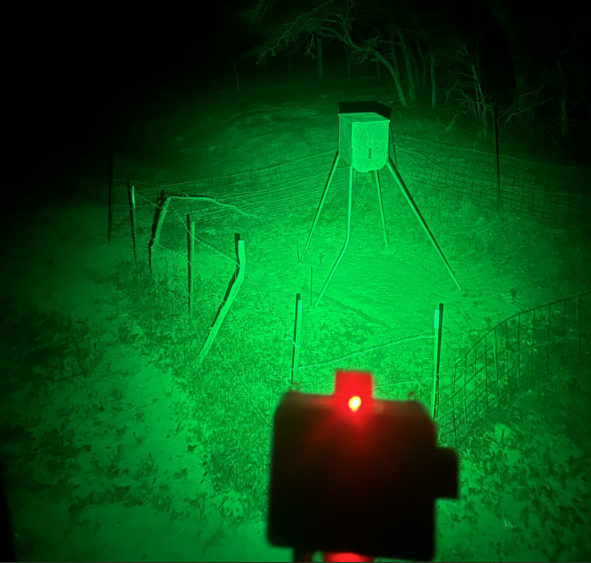
Do Feeder Lights Spook Hogs? What Actually Works?
Table of Contents
- Why Hogs React to Light at the Feeder
- Best Color Light for Hog Hunting: Red, Green, and 850nm IR
- No-Spook Lighting Technology: Why Gradual Illumination Works
- Motion-Activated vs. Constant-On Feeder Lights
- Setup That Reduces Spooking: Height, Angle, and Mounting
- Power and Durability: Solar vs. Battery for Remote Setups
- Conclusion
- Frequently Asked Questions
Last Updated: October 14, 2026
Why Hogs React to Light at the Feeder
Do feeder lights spook hogs? They can. A sudden burst of full-brightness light may startle animals approaching a feeder in darkness. Color matters to hunters, but the speed and intensity of the change also deserve attention. Hogfader builds feeder lighting around that insight, ramping illumination up gradually instead of snapping on.
Feral hogs often become most active at night, especially where hunting pressure or daytime disturbance is high. A mature boar or sow that has spent months approaching a feeder under starlight has learned exactly what that feeder looks like. Change one variable, the light, and you interrupt a routine the animal trusts.
How Hogs See: Photoreceptors, Spectrum, and Night Vision
Like many mammals, hogs have rods that support vision in low light and cones that contribute to color perception. Their response to illumination can depend on brightness, movement, prior experience, and other disturbances—not just the color of a feeder light.
Sudden Light vs. Gradual Light: What Startles a Sounder
A sudden light can cause hogs to stop feeding, look toward the source, or leave the area. A gradual increase is intended to make that transition less disruptive. Reactions vary with the animals and the location; no lighting method guarantees that hogs will remain at the feeder.
Best Color Light for Hog Hunting: Red, Green, and 850nm IR
The best color light for hog hunting depends on your sighting equipment, the property, and how the animals on it behave, not on a universal rule. Red, green, and 850nm infrared all have legitimate roles at a feeder, each with trade-offs worth understanding before you buy.
Light color is measured in nanometers (nm), and the number tells you the wavelength. Red and green occupy different wavelength ranges within the visible spectrum, which is part of why they behave differently in the field (nasa.gov).
- Red: A long-wavelength visible light. Many hunters find it produces the least visible reaction at the feeder, and it preserves your night vision better than white light. The trade-off: red can be harder to see through some optics and can wash out detail on dark-coated animals.
- Green: A shorter wavelength the human eye perceives as brighter than red at the same power, which can make target identification and shot placement easier under a scope. Some hunters report hogs notice green more readily, though this varies by property and sounder, treat that as a field observation, not settled fact.
- 850nm infrared: Not visible light in the practical sense. It only helps if you are running IR-sensitive night vision equipment. See the next subsection for what it does and does not do.
What 850nm Infrared Does (and Doesn’t Do)
Infrared illumination is not just for cameras and recording. An 850nm IR emitter paired with a compatible night vision scope gives you a sight picture without projecting visible light across the feeder. Both the Hogfader Illuminator and the Hogfader Platinum can be configured with 850nm infrared illumination for night hunting with IR-sensitive night vision scopes and other compatible night vision equipment.
Two corrections to common claims. First, 850nm IR is not perfectly invisible; an 850nm LED emitter can produce a faint visible red glow a sharp-eyed animal may pick up at close range. Second, IR night vision is not thermal imaging, thermal optics detect heat signatures and do not require an IR illuminator at all (Infrared Waves).
Matching Color to Your Sighting Setup
The color question is really a gear question. Work backward from your optic:
- Night vision scope or monocular (IR-sensitive): 850nm IR is the natural pairing. You get illumination without projecting a visible beam, and the faint red glow is usually not a factor at typical feeder distances.
- Red or green weapon light / dedicated feeder light with the naked eye or a standard scope: Choose based on how the animals on your property have reacted. If green made hogs edgy, try red. If red was hard to see through your optic, try green.
- Thermal: You do not need an illuminator at all. Thermal sees heat, not reflected light. Adding an IR emitter to a thermal setup does nothing for the sight picture.
Why Color Is Not the Whole Story
Here is the part most color debates miss: color choice matters less than transition speed. A sudden red light may be more disruptive than a green light that brightens gradually; behavior varies by sounder and conditions.
Key Takeaway
Pick your color to match your optic and your property’s history, not to chase a universal “invisible to hogs” claim. No visible color is guaranteed invisible, and no single color is universally superior. The speed of illumination is an important factor to consider alongside color, brightness, and feeder conditions.
Pick your color to match your optic and your property’s history, not to chase a universal “invisible to hogs” claim. No visible color is guaranteed invisible, and no single color is universally superior. The speed of illumination is an important factor to consider alongside color, brightness, and feeder conditions.
No-Spook Lighting Technology: Why Gradual Illumination Works
Hogfader’s No-Spook lighting technology gradually increases brightness to reduce the abrupt change associated with conventional motion-triggered floodlights. The Hogfader Illuminator ramps up over approximately 70 seconds rather than switching on at full brightness.
The Illuminator uses a motion sensor and a day/night sensor to activate after dark. Its gradual ramp is designed to work without a separate light-conditioning period, although individual animals may still react differently. Choose the available illumination option that suits your viewing equipment and hunting conditions.
Motion-Activated vs. Constant-On Feeder Lights
Motion-activated and constant-on lights solve different problems, and neither is automatically better. The right choice depends on whether you want illumination only when animals are present or a permanently lit feeder area.
| Approach | How It Works | Main Advantage | Main Drawback |
|---|---|---|---|
| Constant-on | Light stays on all night | No trigger delay | Continuous power use and broader light exposure |
| Sudden motion-activated | Full brightness on trigger | Instant visibility | May startle animals with an abrupt change |
| Gradual motion-activated | Ramps up over approximately 70 seconds | Gradual transition and reduced unnecessary runtime | Brief wait before full brightness |
Constant-on lighting has a real cost beyond battery drain: it floods the area with ambient light all night, affecting non-target species and making your setup visible to anything moving through the property. Motion activation confines that footprint to the moments that matter.
Watch Out
An ordinary motion floodlight may switch instantly to full brightness. At a feeder, consider a purpose-built light with a controlled brightness transition instead.
An ordinary motion floodlight may switch instantly to full brightness. At a feeder, consider a purpose-built light with a controlled brightness transition instead.
Setup That Reduces Spooking: Height, Angle, and Mounting
Mounting height and angle do more to reduce spooking than most hunters expect. Mount the light high enough that the beam reaches the feeder from above, and angle it down so the brightest part of the field of view lands on the ground and feed, not the approach trail.
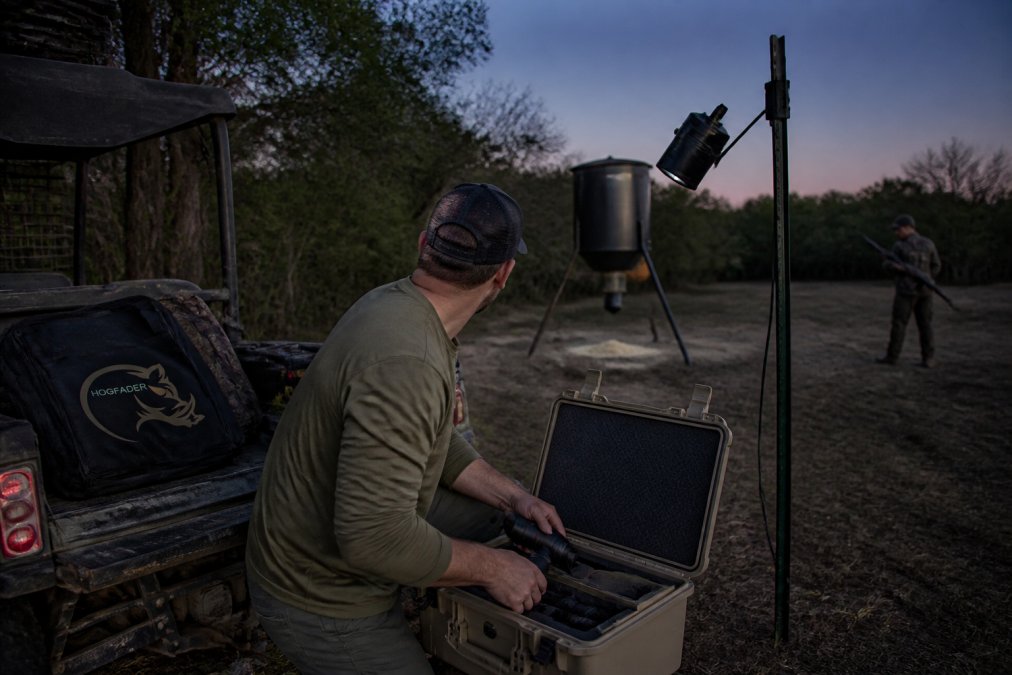
A light that shines horizontally across a clearing silhouettes approaching animals and puts glare in your own optic. A light angled down keeps illumination where the animals already expect to find food. Hogfader systems use standard mounting options, feeder legs, tree trunks, T-posts, fences, and tree branches, so awkward property geometry means repositioning the unit, not rebuilding your setup.
Scent, Sound, and Approach: The Other Spook Factors
Light is only one variable. Scent control and noise discipline still decide most nights, and perfect lighting will not save a hunt where the wind is wrong.
- Approach with the wind in mind; avoid carrying your scent toward the feeder
- Park and walk the last stretch quietly; idling trucks and slamming doors carry
- Set your stand so you are not skylined when the light comes up
- Keep your equipment and movements quiet while observing the feeder
A sounder that has been bumped by scent will not settle just because the light is gentle. Fix the whole approach, not just the illumination.
Power and Durability: Solar vs. Battery for Remote Setups
Power is the part of a feeder light setup that fails quietly. A light that works great in October can be dead by December if the panel is shaded or the battery chemistry does not like cold. Plan the power source before you commit to a location.
Solar-Powered Setups
Solar-powered feeder lights suit remote setups where swapping batteries mid-season is impractical. A solar panel paired with a mounted battery keeps the unit running through the season without routine maintenance trips, provided the panel gets adequate sun.
The catch is canopy. A feeder tucked into deep timber may only see a few hours of direct sun a day, often not enough to keep a battery topped off through cloudy weather. Before mounting a solar unit, watch the intended panel location across a full day and note the hours of direct sun it actually receives. If the answer is “not many,” move the panel to a clearing or plan on battery-only.
Hogfader units are available with solar-powered mounting options and are designed for reliable nighttime operation. If your feeder sits in deep timber, plan panel placement before you commit to a location.
Battery-Only Setups
Battery-only systems are simpler to place under heavy canopy where panels cannot charge effectively. The trade-off is a maintenance schedule you have to keep, a battery-only light is only as reliable as your willingness to drive out and swap cells. A common pattern is battery-only for a short season on a property you visit often, and solar on properties you reach only a few times a year.
Weather and Environmental Variables
Three variables rarely appear in feeder light advice, and each one changes how a powered setup performs over a season.
Humidity, fog, and dust. These scatter light and can make a beam appear brighter and more diffuse than on a clear night. A setup that looks perfect in dry conditions may need a lower angle or a different position after a front moves through.
Moon phase. A bright moon raises the property’s natural ambient light level, changing how much contrast your feeder light adds (Moon Phases). The apparent contrast of a feeder light may differ between bright moonlight and a dark, moonless night. Check your installation under the conditions in which you expect to hunt.
Wind. Wind changes how sound carries and how animals approach. A setup that works on a still night may need a different stand position when the wind pushes your scent toward the feeder.
Non-Target Species and Light Pollution
A feeder lit all night attracts and disturbs more than hogs. Constant-on lighting floods the area with ambient light all night, affecting non-target species and making your setup visible to anything moving through the property. Motion-activated illumination limits that footprint, which matters if you manage for multiple species. A motion-triggered light generally leaves the feeder dark between activations, although it may also activate for animals other than hogs.
Setup tip: Check the beam angle, mounting stability, and solar-panel exposure before hunting. A short nighttime test helps confirm the light illuminates the feeding area without glare.
Habituation: The Long Game
Animals may become accustomed to repeated, non-threatening conditions, but habituation is not predictable for every sounder. Hogfader’s gradual fade is designed to minimize the need to condition hogs to an abruptly switching light.
The Illuminator reaches its programmed peak brightness in approximately 70 seconds. It is intended to provide useful feeder illumination from the first night without requiring a dedicated training period; results depend on field conditions.
Conclusion
Choosing a feeder light involves more than selecting red or green. Brightness, beam placement, activation behavior, and local animal activity all matter. Gradual illumination is one way to reduce the abrupt change that can startle hogs.
Hogfader builds around that principle. The Illuminator uses a roughly 70-second No-Spook fade-up, motion activation, and a day/night sensor, with available lighting configurations and optional solar-powered mounting equipment. The Platinum adds a Wi-Fi camera for local viewing, photos, and recording without a cellular connection or internet service; a nearby phone must connect to the unit’s Wi-Fi network.
Night-hunting regulations vary by state and locality, so confirm your local rules before hunting over a lit feeder. Then get the setup right: mount high, angle down, control scent, and let the light come up slowly.
Get started with Hogfader and build a feeder setup that keeps hogs calm from the first night.
Frequently Asked Questions
What color lights can hogs not see?
There is no color that hogs are completely blind to. Hogs have photoreceptors that detect a range of wavelengths, and while red and green light are commonly used for hog hunting because they may be less disruptive than bright white light, no color is universally invisible to them. The bigger factor in whether hogs spook is how suddenly the light appears and how intense it is, not just the color. Using a light with gradual illumination, like Hogfader’s No-Spook technology, reduces the startle response regardless of whether you choose red, green, or 850nm infrared.
Do feeder lights spook hogs the first time you use them?
They can, especially if the light switches on suddenly at full brightness. Hogs are wary animals and an abrupt change in their environment triggers a flight response. However, lights designed with gradual illumination, such as Hogfader’s No-Spook technology, bring brightness up over approximately 70 seconds, which gives hogs time to adjust without bolting. Many hunters report that hogs remain calm and continue approaching the feeder even on the first night with a gradual-illumination light, though individual sounders may vary.
Is 850nm infrared light visible to hogs?
850nm infrared illumination is at the edge of the visible spectrum. An 850nm LED emitter can produce a faint visible red glow, so it is not completely invisible. That said, hogs are less likely to react to 850nm IR than to a bright white floodlight. It works well with IR-sensitive night vision scopes and other compatible night vision equipment. Keep in mind that IR night vision is different from thermal imaging; thermal optics detect heat and do not need an IR illuminator at all.
What is the best feeder light for hog hunting?
The best feeder light for hog hunting is one that minimizes sudden changes in illumination. Look for a motion-activated light with gradual brightening, like Hogfader’s No-Spook technology, which raises illumination over approximately 70 seconds so hogs are less likely to startle. Color options like red, green, and 850nm infrared let you match the light to your night vision equipment and hunting conditions. Solar-powered mounting options help keep the light running in remote locations without frequent battery changes.