
How to Stop Hogs From Spooking at Your Feeder
Table of Contents
- Why Feral Hogs Spook at Feeders
- Feral Hog Behavior at Night: What You Need to Know
- Scent and Sound Management
- Using Red vs Green Light for Hog Hunting
- How Gradual Illumination Helps Prevent Spooking
- Choosing Night Vision Equipment
- Monitoring Hog Feeders With Local Wi-Fi
- Frequently Asked Questions
Updated: October 14, 2026
Why Feral Hogs Spook at Feeders
Feral hogs rely heavily on their senses of smell and hearing to detect potential danger. Sudden changes in their surroundings, including unexpected noises, unfamiliar scents, and abrupt lighting changes, can cause them to become cautious or leave a feeding area.
For hunters trying to establish consistent nighttime activity around a feeder, minimizing these disturbances is important. A feeder that provides a predictable environment is generally more inviting than one where animals repeatedly encounter unexpected activity.
Three common causes of spooking include:
- Sudden illumination: Motion-activated floodlights that immediately switch to full brightness can startle animals accustomed to darkness.
- Human scent: Approaching a feeder without considering wind direction can alert hogs before they become visible.
- Unexpected noises: Vehicle doors, equipment movement, and other unfamiliar sounds can interrupt feeding activity.
Although no single technique can eliminate every disturbance, combining careful feeder placement, scent management, and gradual illumination can help create a more consistent nighttime feeding environment.
Feral Hog Behavior at Night: What You Need to Know
Feral hogs are highly adaptable animals. Although they may be active during daylight, they frequently become more nocturnal in areas experiencing hunting pressure or human activity.
They use their senses to evaluate feeding locations and may approach cautiously, particularly when unfamiliar objects or changes are present.
Hogs can also adjust their feeding schedules according to food availability, weather conditions, and disturbances around a feeder.
Understanding these behavioral patterns helps hunters make better decisions about feeder placement, lighting, and hunting schedules.
One important consideration is consistency. Maintaining a familiar feeding environment while minimizing unnecessary disturbances may encourage hogs to continue visiting a location.
Scent and Sound Management
Effective scent and sound management can make a significant difference when hunting feral hogs.
Hogs possess an excellent sense of smell, making wind direction particularly important when approaching a feeder or hunting position.
Practical recommendations include:
- Consider prevailing wind direction when selecting a hunting location.
- Approach your hunting position using a route that minimizes scent drifting toward the feeder.
- Avoid unnecessary activity around the feeder shortly before hunting.
- Keep equipment and clothing free from strong or unfamiliar odors whenever practical.
- Minimize sudden noises while approaching and occupying your hunting position.
Even an effective feeder light cannot compensate for every disturbance. Combining responsible hunting practices with consistent lighting conditions provides a better overall approach.
Pro Tip
Plan your approach before arriving at the property. Wind direction, vehicle placement, and unnecessary movement around the feeder can influence nighttime hog activity.
Plan your approach before arriving at the property. Wind direction, vehicle placement, and unnecessary movement around the feeder can influence nighttime hog activity.
Using Red vs Green Light for Hog Hunting
Red and green feeder lights are both popular choices for nighttime hog hunting. Each offers different advantages depending on the hunting environment and the hunter’s preferences.
Neither color should be considered completely invisible to hogs. Brightness, beam characteristics, and the way illumination is introduced can all influence an animal’s reaction.
- Red light: Red illumination is commonly preferred by hunters who want to preserve more of their natural night vision. It can provide useful visibility around a feeder without appearing as bright to the human eye as comparable green illumination.
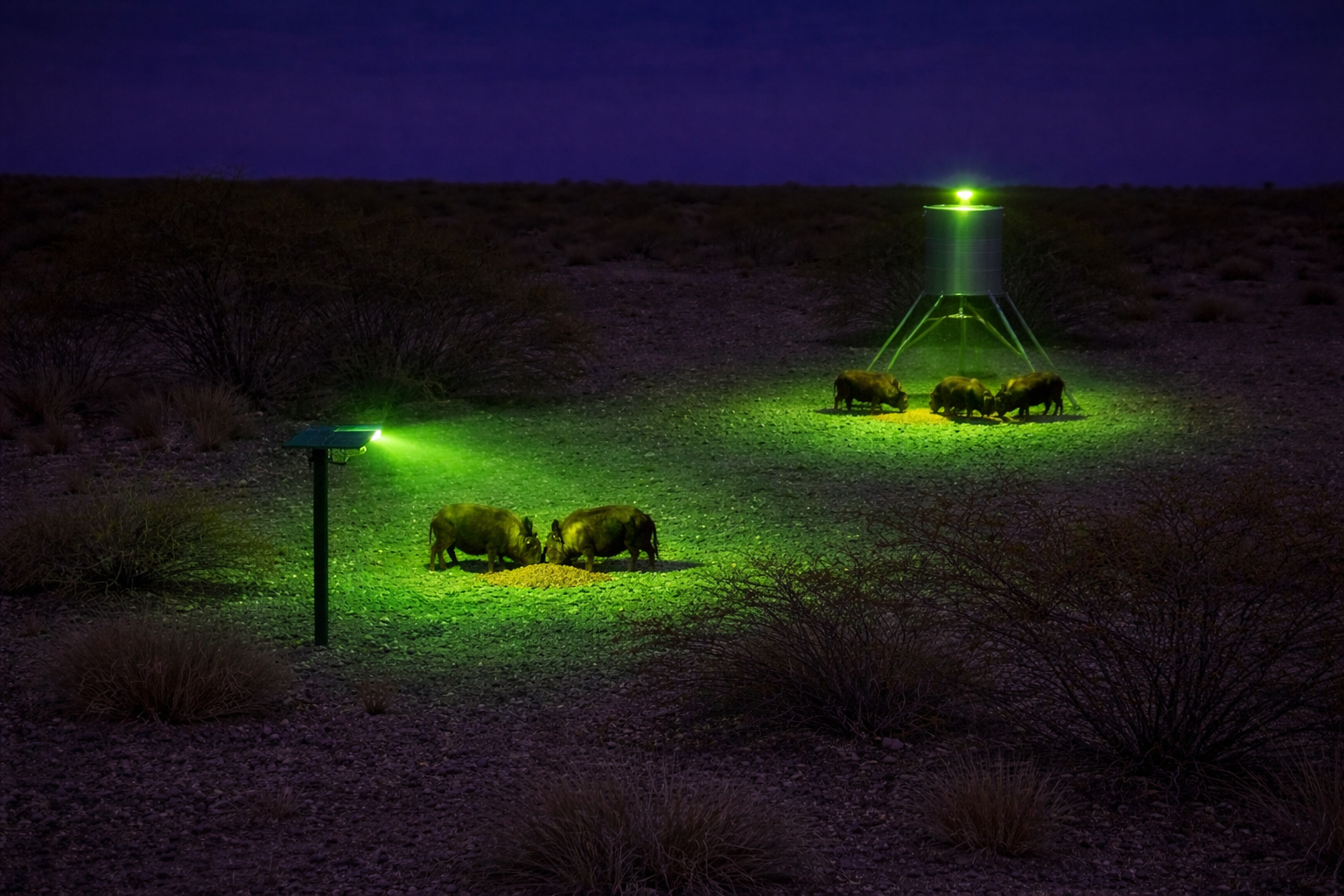
- Green light: Green illumination generally appears brighter to the human eye and can provide excellent contrast when observing animals and surrounding terrain. It is particularly popular for hunting around open fields and larger feeding areas.
- 850nm infrared: Infrared illumination is designed for use with compatible infrared-sensitive night vision equipment, including digital night vision scopes. It is not intended for viewing with the unaided human eye. Some 850nm LED emitters may produce a faint visible red glow at the source.
Infrared illumination should not be confused with thermal imaging. Thermal devices detect differences in heat and do not require an infrared illuminator.
Hogfader offers red and green feeder lighting, along with infrared options for compatible night vision applications.
While color selection is important, the way a feeder light reaches its operating brightness deserves equal attention.
A light that instantly switches from darkness to full brightness introduces a sudden environmental change. A light that gradually increases in brightness provides a less abrupt transition.
This principle is central to Hogfader’s No-Spook feeder lighting technology.
When selecting a feeder light, consider your hunting distance, surrounding terrain, preferred lighting color, and whether you use conventional optics or infrared-sensitive night vision equipment.
Always verify applicable state and local regulations before using artificial lighting or night vision equipment for hunting.
Key Takeaway
Choosing the right lighting color matters, but controlling how quickly that light reaches full brightness can be just as important. Gradual illumination helps minimize sudden changes around the feeder.
Choosing the right lighting color matters, but controlling how quickly that light reaches full brightness can be just as important. Gradual illumination helps minimize sudden changes around the feeder.
How Gradual Illumination Helps Prevent Spooking
One of the most important differences between conventional motion-activated feeder lights and Hogfader’s Illuminator is the way illumination is introduced.
Many conventional motion lights activate almost instantly at their operating brightness. This sudden transition can startle animals that have become accustomed to a dark feeding area.
Hogfader developed its No-Spook illumination technology specifically to address this problem.
How Hogfader’s No-Spook Technology Works
The Hogfader Illuminator uses a carefully programmed lighting sequence designed to minimize abrupt changes in illumination.
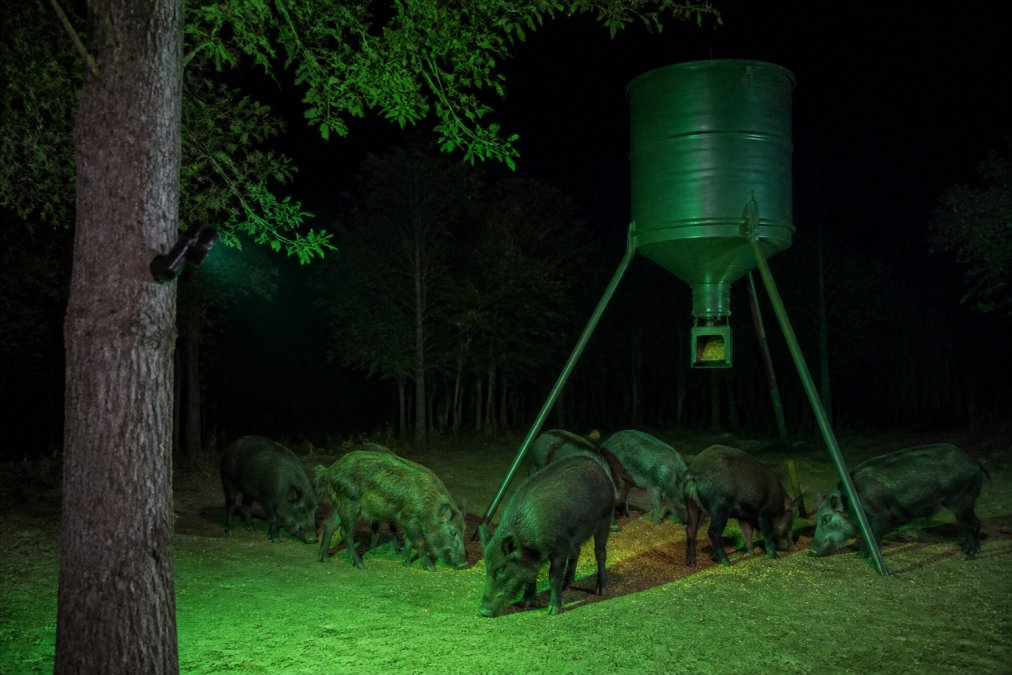
- 70-second fade-up: When motion is detected, the light begins at a very low brightness and gradually increases over approximately 70 seconds.
- 120-second hold: After reaching its programmed maximum brightness, the light remains illuminated for approximately two minutes.
- Motion extension: Additional motion can extend the illumination period according to the light’s programmed operating sequence.
- 45-second fade-down: The light gradually decreases in brightness rather than abruptly switching off.
This gradual illumination sequence gives animals time to adjust to changing light levels while providing hunters with useful visibility around the feeder.
Unlike lighting systems that require animals to become accustomed to a continuously illuminated feeder, Hogfader’s approach is designed to operate without a lengthy training period.
Although animal behavior can never be guaranteed, field experience with Hogfader lighting has demonstrated that hogs can continue approaching and feeding while the illumination gradually increases.
The Illuminator also incorporates motion detection and automatic day/night operation, allowing the lighting sequence to activate when appropriate without requiring manual control.
Learn more about the Hogfader Illuminator feeder light.
Choosing Night Vision Equipment
Night vision equipment can provide additional flexibility for hunters who prefer observing feeder activity without relying on visible red or green illumination.
When selecting equipment, it is important to understand the difference between infrared-sensitive night vision and thermal imaging.
Digital night vision devices use electronic image sensors to capture available light. Many models can also detect infrared illumination that is not readily visible to the human eye.
For hunters using compatible digital night vision scopes, an 850nm infrared feeder light can illuminate the feeding area while allowing the scope to produce a usable image.
Important considerations include:
- Infrared compatibility: Confirm that your night vision device supports 850nm infrared illumination.
- Viewing distance: Select equipment appropriate for the distance between your hunting position and feeder.
- Image quality: Resolution, sensor sensitivity, and lens characteristics affect nighttime visibility.
- Battery performance: Consider expected operating time and available charging options.
- Lighting placement: A feeder-mounted infrared illuminator can provide illumination at the feeding location rather than requiring the light source to be positioned beside the hunter.
Thermal imaging equipment operates differently. It detects heat signatures and does not require infrared illumination to function.
For hunters already using compatible infrared-sensitive equipment, a properly positioned feeder light can provide a useful addition to their nighttime hunting setup.
Pro Tip
Before purchasing an infrared feeder light, verify that your night vision equipment is compatible with the intended wavelength. Infrared-sensitive night vision and thermal imaging are different technologies.
Before purchasing an infrared feeder light, verify that your night vision equipment is compatible with the intended wavelength. Infrared-sensitive night vision and thermal imaging are different technologies.
Monitoring Hog Feeders With Local Wi-Fi
Modern feeder lighting systems can also incorporate camera technology, allowing hunters to observe activity around a feeder.
The Hogfader Platinum combines feeder illumination with an integrated camera and local Wi-Fi connectivity.
Unlike cellular camera systems that depend on mobile network coverage, the Platinum creates its own local Wi-Fi network.
This allows a compatible smartphone to connect directly to the unit without requiring cellular service or an internet connection.
When connected within the unit’s available Wi-Fi range, users can access camera functions through the Platinum’s browser-based interface.
Depending on the operating configuration, available features include:
- Viewing a live camera stream.
- Capturing photographs.
- Recording video.
- Downloading captured media to a connected device.
Because the connection uses local Wi-Fi, the smartphone must remain within communication range of the Platinum unit. The system is not intended to provide remote viewing over the internet from another location.
This approach can be particularly useful on ranches and hunting properties where cellular coverage is unreliable or unavailable.
Learn more about Hogfader Platinum camera-equipped feeder lights.
Frequently Asked Questions
What causes feral hogs to spook at night?
Feral hogs can become startled by sudden bright lights, unfamiliar human scent, unexpected noises, and changes in their surroundings. Reducing these disturbances can help create a more consistent feeding environment.
Do hogs see red or green light better?
Red and green illumination provide different advantages for hunters, but neither color should be considered completely invisible to hogs. Green generally appears brighter to human observers, while red may be preferable for preserving night vision. Gradual illumination can help reduce abrupt lighting changes regardless of the selected color.
How does gradual illumination help prevent hogs from spooking?
Gradual illumination reduces the sudden transition from darkness to full brightness. Hogfader’s Illuminator uses a programmed 70-second fade-up, followed by a two-minute illumination period and a gradual fade-down. This approach is designed to minimize startling changes around a feeder.
Does Hogfader’s No-Spook technology require a training period?
No. Hogfader’s No-Spook lighting technology is designed to allow hogs to approach and feed without requiring a lengthy period of exposure to a continuously illuminated feeder. Actual animal behavior can vary according to hunting pressure and environmental conditions.
Is 850nm infrared light visible to feral hogs?
850nm infrared illumination is primarily intended for compatible infrared-sensitive night vision equipment. Although the infrared output is outside the normal visible spectrum, some LED emitters produce a faint visible red glow. It should not be described as completely undetectable.
Can Hogfader Platinum operate without cellular service?
Yes. Hogfader Platinum uses local Wi-Fi connectivity and does not require cellular service or internet access for direct smartphone connection. Users must remain within the unit’s available Wi-Fi communication range.