
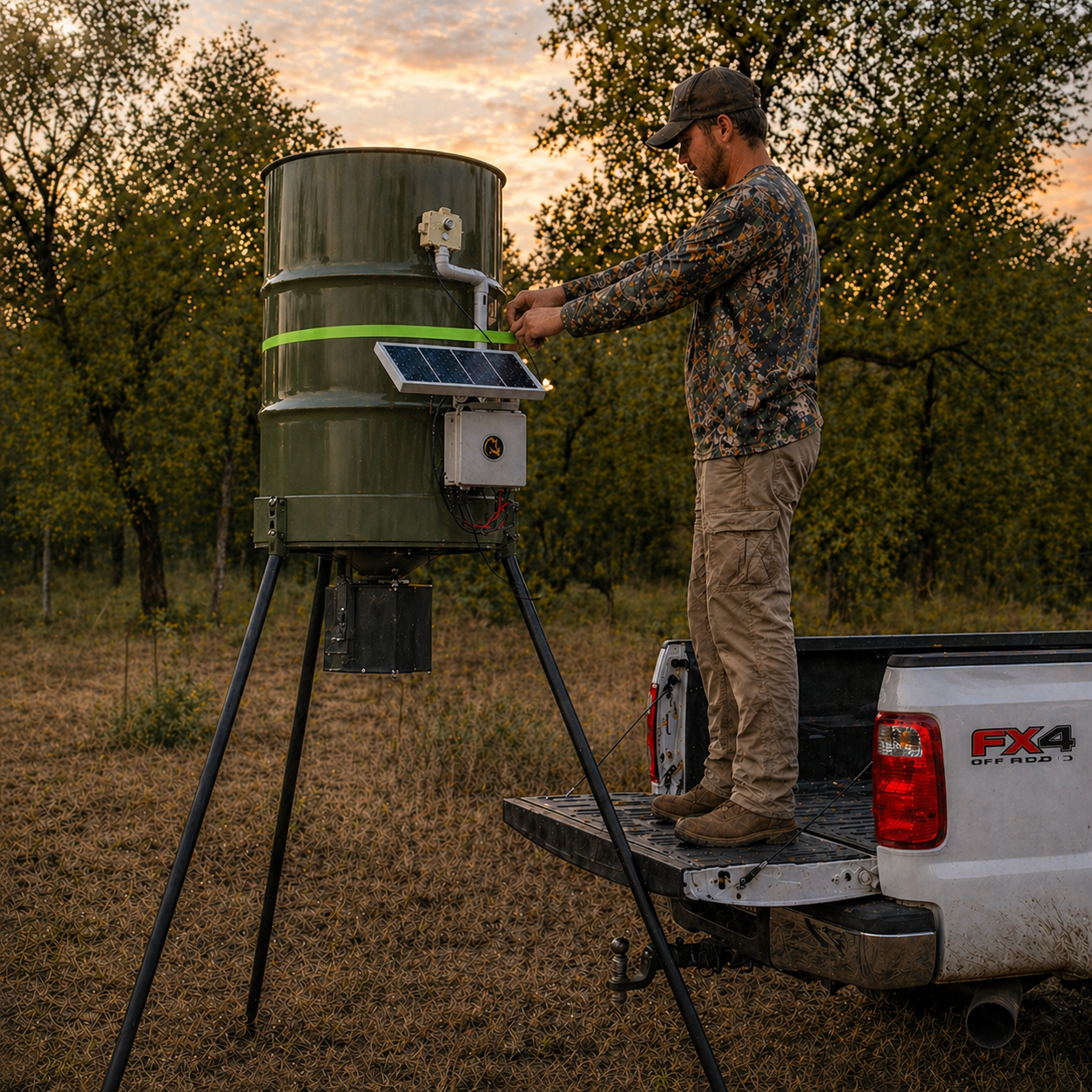
Best Light for Hog Hunting at Night
Table of Contents
- What Makes a Hog Hunting Light Effective at Night
- The Problem With Conventional Feeder Lights
- Red vs Green Light for Hog Hunting: How to Choose
- 850nm Infrared for Night Vision Hunting
- No-Spook Lighting Technology and Why Gradual Illumination Matters
- Light Discipline and Setup: Getting the Best Light for Hog Hunting at Night to Work
- Night Hunting Regulations and Maintenance: What to Check Before You Hunt
- Frequently Asked Questions
Last Updated: October 14, 2026
What Makes a Hog Hunting Light Effective at Night
Finding the best light for hog hunting at night comes down to one principle: illumination that hogs tolerate rather than fear. Feral hogs are alert to changes in their surroundings, including abrupt changes in brightness. Gradual illumination can reduce one potential source of disturbance compared with a light that switches instantly to full power. At Hogfader, we build feeder lighting around that exact behavior, because a light that spooks the sounder defeats its own purpose.
The Problem With Conventional Feeder Lights
A standard motion floodlight is designed for security, not for wildlife. It triggers instantly, floods the area with harsh white light, and stays on a fixed timer. Sudden changes in illumination can startle hogs and interrupt feeding activity, although their reactions vary with the animals and conditions.
Red vs Green Light for Hog Hunting: How to Choose
Red and green are both legitimate choices for night hunting, and neither is universally invisible to hogs. Anyone who tells you one color is always superior is overselling. What differs in practice is how the colors appear to hunters, the equipment used, and the conditions at the feeder.
What We Know About Hog Vision
Feral hogs are not colorblind in the way many hunters assume. Their retinas are dominated by rod cells, which excel at low-light detection, and they have a limited complement of cone cells. The practical takeaway is that hogs detect motion and brightness changes far better than they resolve color detail. That is one reason to consider how quickly a feeder light brightens, rather than choosing solely by color.
Practical Differences Between Red and Green
| Light Color | Practical Strength | Best For | Watch For |
|---|---|---|---|
| Red | Easier on night-adjusted eyes; less perceived glare | Close-range feeder setups, hunters who scan frequently | Less perceived brightness at distance |
| Green | Brighter perceived output to the human eye | Longer-range identification, detail on target | Can read harsh if it snaps on suddenly |
| 850nm IR | Works with IR night vision scopes | Scoped night hunting with compatible night vision | Faint visible red glow from the emitter |
Green tends to appear brighter to the human eye at the same power level, which helps with identification at distance but can also wash out your scope picture if the beam is too wide. Red preserves your own night vision better during long sits and is often preferred for close feeder work where the shot window is short. Neither is wrong.
The Variable That Actually Changes Outcomes
The transition matters more than the wavelength. A sudden jump to full brightness may startle hogs regardless of color. A gradual fade can make the transition less abrupt. Learn more in our red vs. green hog hunting light guide.
Key Takeaway
Pick the color that fits your optic and your eyes. Then make sure the light ramps up slowly. Color matters for visibility and equipment compatibility; the speed of illumination is another important consideration.
Pick the color that fits your optic and your eyes. Then make sure the light ramps up slowly. Color matters for visibility and equipment compatibility; the speed of illumination is another important consideration.
850nm Infrared for Night Vision Hunting
Infrared is not just for trail cameras. HOGFADER uses 850nm IR illumination for night hunting with IR-sensitive night vision scopes and other compatible night vision equipment, and 850nm IR configurations are available for compatible night-vision applications. Check the current options for the HOGFADER Illuminator and HOGFADER Platinum before ordering. One caveat worth stating plainly: 850nm is not completely invisible. An 850nm LED emitter can produce a faint visible red glow, so do not expect total concealment.
IR Night Vision vs Thermal Optics
These are different tools, and confusing them leads to bad purchases. IR night vision needs an illuminator to light the scene, which is why a 850nm IR source pairs with it. Thermal optics detect heat signatures and do not require an IR illuminator at all. If you run thermal, a feeder light is for your own visibility and camera work, not for the optic.
No-Spook Lighting Technology and Why Gradual Illumination Matters
Pro Tip
The biggest mistake with feeder lighting is judging it by how bright it looks to you. Judge it by how hogs respond. The HOGFADER Illuminator fades in over approximately 70 seconds to avoid an abrupt change in brightness. Animal responses can still vary.
The biggest mistake with feeder lighting is judging it by how bright it looks to you. Judge it by how hogs respond. The HOGFADER Illuminator fades in over approximately 70 seconds to avoid an abrupt change in brightness. Animal responses can still vary.
Motion sensing and automatic day/night operation mean the system runs without you babysitting it, and solar-powered mounting options keep remote setups running. The gradual ramp is the point. Motion activation alone does not guarantee a gentle lighting transition.
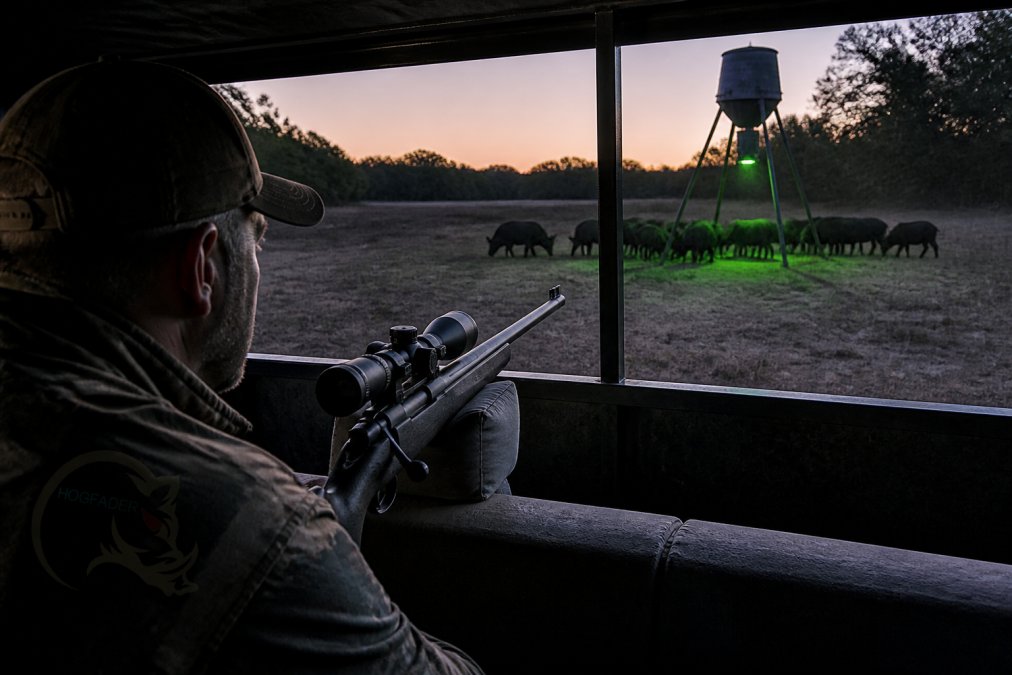
Light Discipline and Setup: Getting the Best Light for Hog Hunting at Night to Work
Setup decides whether good hardware performs. Light discipline means controlling where illumination lands, keeping it off your own position, and avoiding spill that washes out your scope picture. Most guides stop at “mount it and turn it on.” Thoughtful placement can improve visibility while limiting unwanted glare and light spill.
The Principles Behind Good Light Discipline
Every setup decision comes back to three questions: Where do hogs approach from? Where do you need to see them? Where should the light never land?
- Illuminate the feeder zone, not the approach trail. Aim the beam at the feeder area you want illuminated, while minimizing unnecessary spill into surrounding areas.
- Keep the beam off reflective surfaces and your blind. A single reflective leaf or a dew-covered panel can bounce light back into your scope and ruin your night-adapted vision for minutes.
- Choose a beam that evenly covers the feeder area. An overly narrow beam can leave dark edges, while excessive spill may cause glare. Match the beam to the feeder layout.
- Test the ramp behavior before the season. A light that snaps to full brightness, or fails to switch on at all, costs you the sit. Run a full cycle at dusk a week before you hunt.
Mounting Options for Feeders, Trees, and T-Posts
HOGFADER lights are built for versatile mounting on feeders, tree trunks, T-posts, fences, and tree branches, which matters on smaller properties where the perfect setup is not available. How you mount changes what you see:
- Higher mounts throw light farther and cover more ground but can spill into the approach trail and cast longer shadows behind the feeder.
- Lower mounts with a tighter beam reduce spill and keep light concentrated on the kill zone, but may not reach the far edge of a large feeder area.
- Angled-down mounts on tight-cover setups keep light off surrounding brush and reduce the chance of backscatter into your optic.
Scanning Techniques That Preserve Your Night Vision
How you use the light matters as much as where it points. A few habits separate productive sits from frustrating ones:
- Observe the feeder area without sweeping the fixed light. HOGFADER feeder lights are designed to remain mounted and aimed at the feeder. Avoid moving the light or repeatedly changing its direction.
- Position the light for usable visibility. More light is not always better. The Illuminator uses an automatic fade sequence rather than a user-adjustable brightness dial. Set the mounting angle to provide clear visibility without excessive glare.
- Avoid unnecessary changes in lighting. Once mounted, keep the beam directed toward the feeder rather than sweeping it across the area.
- Protect your night adaptation. Avoid looking directly into the LEDs and minimize exposure to bright screens or other unnecessary light sources.
Adapting When the Ideal Setup Is Not Available
Watch Out
Skipping a pre-season ramp test is how hunters discover a problem at 10 p.m. with hogs at the feeder. A light that snaps to full brightness, or fails to switch on at all, costs you the sit.
Skipping a pre-season ramp test is how hunters discover a problem at 10 p.m. with hogs at the feeder. A light that snaps to full brightness, or fails to switch on at all, costs you the sit.
Motion sensing and automatic day/night operation mean the system runs without you babysitting it, and solar-powered mounting options keep remote setups running. The gradual ramp is the point. Motion activation alone does not guarantee a gentle lighting transition.
Night Hunting Regulations and Maintenance: What to Check Before You Hunt
Night hunting regulations vary by state and locality, and they change. Some states allow night hunting for feral hogs year-round, others restrict it to certain seasons, require a permit, or prohibit artificial light entirely. Never assume night hog hunting is legal where you hunt. Check your state wildlife agency’s current rules and any local ordinances before you go, and confirm whether artificial light or night vision equipment is permitted for your specific situation.
- Inspect the housing and seals for cracks or water intrusion
- Clean the lens and any IR emitter surface with a soft cloth
- Verify the motion sensor triggers reliably at the distances you hunt
- Confirm the solar panel is clear of debris and charging
- Test the day/night automatic switching at dusk
- Check mounting hardware for corrosion and tightness
- Run a full ramp cycle to confirm the approximately 70-second fade-in works
Frequently Asked Questions
What color light is best to hunt hogs at night?
There is no single best color for every setup. Red and green are both legitimate choices for a hog hunting light. Many hunters prefer red because it is often described as less disruptive to night vision, while green can appear brighter to the human eye at the same output and may help with target acquisition. The more important factor is how the light turns on. A gradual transition, like the no-spook lighting technology in Hogfader systems, is intended to reduce the abrupt change that can startle hogs at a feeder.
Do I need infrared or visible light for night hunting?
It depends on your optic. If you run an IR-sensitive night vision scope, 850nm infrared for night vision hunting lets you see without much visible light. Note that an 850nm LED emitter can produce a faint visible red glow, so it is not completely invisible. If you shoot with a standard scope or open sights, you need a visible red or green feeder light. Thermal optics do not require an IR illuminator at all. Match the light to the equipment you actually hunt with.
Will hogs spook the first time I use a gradual-illumination feeder light?
No lighting system can guarantee that every hog will remain calm. What separates Hogfader from a conventional motion light is the behavior of the light itself: instead of switching instantly to full brightness, it ramps up gradually over approximately 70 seconds on the HOGFADER Illuminator. That slower transition is intended to reduce startling caused by an abrupt burst of light. Hogfader designs its systems around this approach and does not require a training period for hogs to adjust.
What should I check before hunting hogs at night on my property?
Start with your state and local regulations, because night-hunting rules for feral hogs vary widely and some areas require permits or restrict methods. Then set up for light discipline: mount your feeder light so the beam covers the feeder without spilling toward your position or a neighbor’s property. Weatherproofing matters too, so look for sealed housings and a solid mount. Solar-powered options reduce trips to swap batteries at remote feeders, and a Wi-Fi camera system like the Hogfader Platinum lets you view the feeder without cellular service.