
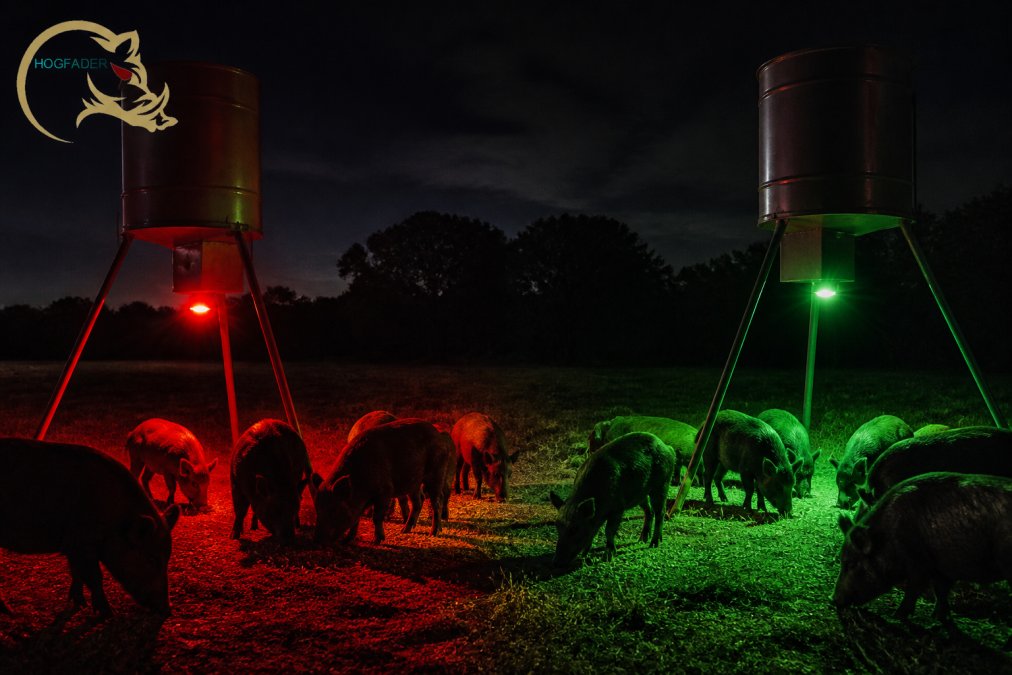
Red vs Green Light for Hog Hunting: What Works at Night
Table of Contents
- How Feral Hogs See Light: What Dichromatic Vision Means for Your Setup
- Red vs Green Light for Hog Hunting: A Side-by-Side Comparison
- NO-SPOOK Illumination: How Gradual Brightening Works
- 850nm Infrared for Night Hunting: Matching IR to Your Optic
- Night Hunting Regulations by State: What You Must Verify Before You Hunt
- Light Discipline, Environmental Variables, and Battery Performance
- Choosing the Right Hog Hunting Light for Your Setup
- Frequently Asked Questions
Last Updated: October 13, 2026
How Feral Hogs See Light: What Dichromatic Vision Means for Your Setup
Choosing red vs green light for hog hunting starts with your viewing equipment and the feed area you need to illuminate. Pig vision differs from human vision, but retinal anatomy alone does not tell you which light a feral hog will tolerate. This guide compares the practical choices, explains where 850nm infrared fits, and covers setup and power considerations.
Dichromatic vision refers to a visual system with two cone types. A study of the domestic pig retina identified medium- and short-wavelength-sensitive cones. This supports a narrower range of color discrimination than human trichromatic vision; it does not establish that red or green feeder lights are invisible to hogs.
What Pig Retinal Research Tells Us About Color Vision
The same domestic-pig study examined cone distribution and reported high cone density in parts of the retina. Its findings concern retinal anatomy, rather than a comparison of red and green hunting lights. They do not establish which color causes less disturbance at a feeder.
For a hunter, the useful distinction is between an animal detecting light and distinguishing its color. Limited color discrimination does not mean an illuminated area goes unnoticed. Avoid treating red as invisible or green as guaranteed to spook hogs.
Evaluate intensity, beam placement, activation, and activity at your feeder alongside color. No one feature guarantees how animals will respond.
Red vs Green Light for Hog Hunting: A Side-by-Side Comparison
Red and green are both visible-light options for unaided viewing and conventional optics used with artificial illumination. Compare usable detail through your actual scope at your intended distance. Neither color is universally better for every property or hunter.
|
Factor |
Red Light |
Green Light |
|---|---|---|
|
Spectrum |
Visible red; longer wavelength than green |
Visible green; shorter wavelength than red |
|
Human night vision impact |
Dim red can help retain dark adaptation; bright red is not harmless |
Can affect dark adaptation; intensity and exposure matter |
|
Perceived brightness |
Assess usable detail with the actual light and optic |
May look brighter, but electrical power alone is not a fair comparison |
|
Contrast against vegetation |
Depends on background, beam, and optic |
Depends on background, beam, and optic |
|
Common use case |
Visible illumination where red gives adequate detail |
Visible illumination where green gives adequate detail |
What the Table Does Not Tell You
This comparison is a setup guide, not a tested ranking of hunting success. FAA guidance on human night vision describes the usefulness of dim red lighting and the loss of dark adaptation after bright-light exposure; that does not make a bright red hunting light harmless to your night vision. Light output, beam shape, your optic, the background, and viewing conditions all affect what you can see.
Beam pattern changes coverage. A narrow beam concentrates illumination in a smaller area; a wider beam spreads it across more ground. For a fixed feeder, choose coverage that lets you see the animal and its surroundings clearly without excessive spill into your viewing position. Beam shape alone does not establish how hogs will react.
Contrast is terrain-specific. Vegetation, bare ground, and the animal reflect red and green differently. A brighter background is not automatically better target contrast. Compare the complete scene through your optic instead of assuming green always performs better around foliage or red always reduces glare.
Color choice interacts with your optic. A conventional daylight scope needs sufficient visible light for you to see the target. IR-sensitive night vision can use compatible infrared illumination; some devices also respond to visible light. Confirm the equipment requirements rather than assuming every night vision scope needs the same wavelength.
How to Test the Difference on Your Own Property
A practical comparison at your feeder can help you choose a viewing setup:
- Install the light at the height and angle you will use, then view the feed area from your actual stand.
- Check target detail, background visibility, glare, and coverage with your chosen optic.
- If comparing colors, keep mounting position and beam coverage as similar as possible. The same power setting does not necessarily mean the same visible brightness.
- Record weather, ambient light, activity, and unwanted activations over several visits. Avoid assigning one observed response to color alone.
Treat these observations as local experience, not a controlled test of hog vision or proof that a particular color causes a response. Different animals, weather, activity, and hunting pressure can affect what you observe.
Pro TipChoose the color that gives you a clear view through your optic, then check coverage, glare, and activation. Test the installation at night before relying on it during a hunt.
Where HOGFADER Fits This Decision
The HOGFADER Illuminator offers red, green, and 850nm infrared options. Red and green versions brighten gradually over 70 seconds from dim standby when motion is detected. The IR version changes intensity on motion detection for power conservation and does not use that red/green fade. Optional mounting and solar charging equipment can support locations away from an outlet; check the selected package and battery requirements.
NO-SPOOK Illumination: How Gradual Brightening Works
When comparing feeder lighting, check how it activates as well as how bright it gets. An immediate brightness change and a gradual fade produce different lighting conditions. HOGFADER uses gradual activation in its red and green lights to avoid a sudden jump to full output.
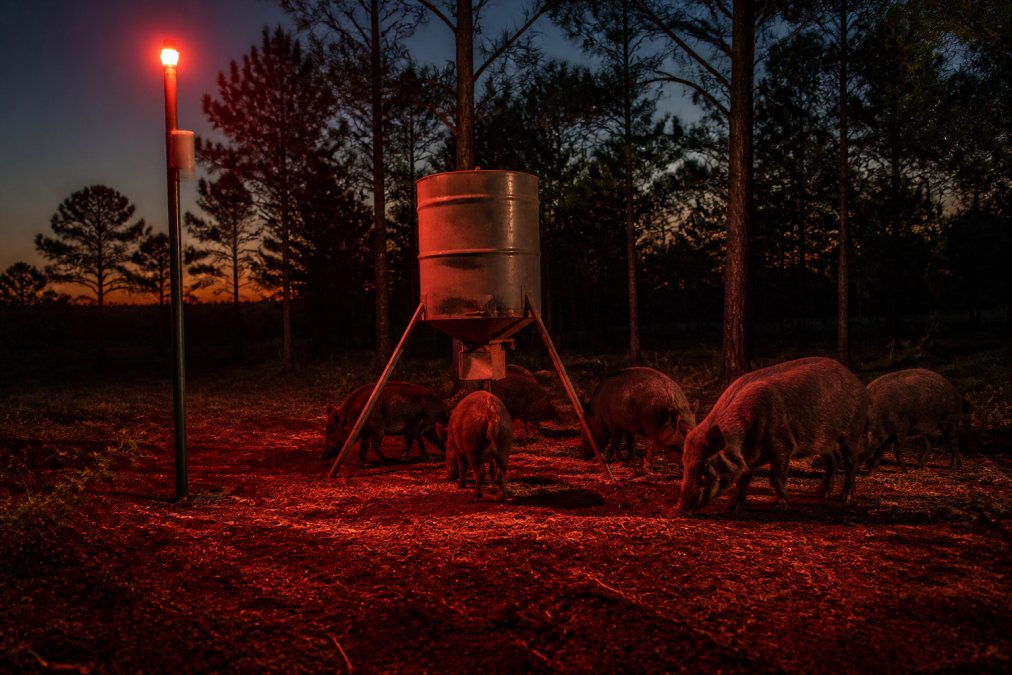
The Illuminator and Platinum red and green versions use the 70-second NO-SPOOK fade. It is designed to reduce abrupt changes in illumination at the feeder. The name describes the design intent, not a guarantee that hogs will remain calm or continue feeding.
Pro TipThe 70-second fade applies to red and green HOGFADER lights. The 850nm IR version changes intensity when motion is detected for power conservation; choose it for compatible IR-sensitive viewing equipment.
HOGFADER is designed for use without a prescribed training period. Install and test the light, then observe activity at your feeder; immediate acceptance by every animal is not guaranteed.
850nm Infrared for Night Hunting: Matching IR to Your Optic
An 850nm infrared illuminator is a hunting tool as well as a camera accessory. It provides reflected near-infrared light for IR-sensitive night vision scopes and other compatible equipment. It does not illuminate the feeder for your unaided eyes. Confirm 850nm compatibility with your optic manufacturer before selecting IR.
Both the HOGFADER Illuminator and HOGFADER Platinum offer an 850nm infrared option. Choose IR when your viewing equipment can use it; choose red or green when you need visible illumination. The IR model does not use the red/green gradual fade.
Infrared-assisted night vision and thermal imaging are different. Thermal optics detect emitted thermal radiation and do not need an 850nm illuminator to form their image. Do not describe an IR setup as completely undetectable: visibility of the emitter and any indicator lights is separate from whether the illuminated scene is visible to unaided eyes.
Night Hunting Regulations by State: What You Must Verify Before You Hunt
Before using a night hunting feeder-light setup, verify the current rules for your location and method. Requirements can depend on state, land ownership, licenses or permits, baiting, artificial light, and optical equipment. This guide does not determine what is legal at your property.
Consult your state wildlife agency and the relevant land manager or local authority where applicable. Confirm landowner permission, required licenses or permits, and the rules for the specific equipment you intend to use before hunting.
Watch OutCheck current rules for your location, land type, and hunting method. Do not rely solely on what was permitted last season.
Light Discipline, Environmental Variables, and Battery Performance
Light discipline means controlling where illumination falls and how much you use. A stable installation, a clear view through your optic, and attention to the conditions at your feeder help you evaluate the setup. Color is only one part of that decision.
Light Placement and Viewing Checks
Aim at the feeding area. Direct a fixed feeder light downward onto the ground where animals feed. Check that it covers enough of the surrounding area for identification and awareness of what lies beyond the target, without shining directly toward your stand.
Check the whole beam. Look at both the brightest area and the surrounding spill. Re-aim the light if nearby branches or feeder hardware create glare or block your view. Avoid drawing conclusions about hog reactions from beam edges alone.
Plan how you will observe the feeder. Use a viewing method suited to the conditions, whether visible illumination, compatible night vision, or thermal. Do not wait until the moment of a shot to discover that the animal or surroundings cannot be identified clearly.
Keep a fixed feeder light stable. Secure the mounting hardware and aim the beam at the feed area. Unnecessary movement changes the scene and makes it harder to judge coverage consistently.
Test from your actual stand. Mounting height and angle affect coverage and glare. Evaluate the light from the position and through the optic you will use, rather than relying on how it looks while standing beside the feeder.
Environmental Variables That Change Effective Illumination
Fog, dust, and airborne moisture can scatter light, create glare, and reduce usable detail. The result depends on particle conditions, beam placement, intensity, and your optic. Do not assume red always penetrates fog better or that green always produces more haze.
Branches and foliage can block illumination and sight lines, while nearby surfaces may reflect light back toward you or a camera. Moonlight and other ambient light also change the scene. Test coverage under the conditions you expect instead of assuming a particular moon phase requires more or less output.
Temperature affects battery capacity and charging, so follow the battery and controller specifications. HOGFADER offers solar charging and mounting options, but runtime depends on sunlight, battery condition, and total energy use. Include dim standby, sensing and control electronics, brighter activation periods, and camera operation on Platinum. Automatic day/night operation does not mean zero standby power use.
Building a Pre-Season Light Plan
Before the season starts:
- Confirm your mounting position and beam angle against the actual approach path.
- Test visibility and power under expected weather and cover conditions, following the equipment operating limits.
- Decide your scanning method in advance so you are not improvising with a bright beam in the field.
- Verify your power source will carry you through your coldest expected hunt nights.
- Re-check applicable regulations before hunting.
Watch OutCheck battery condition, charging, and actual equipment use. Frequent activation and camera operation can increase consumption; solar charging must keep pace over time, with battery reserve for reduced sunlight.
Why Transition Behavior Belongs in Your Light Plan
Include activation in your setup check. Red and green HOGFADER lights fade up over 70 seconds, while the 850nm IR version changes intensity on motion detection without that fade. Confirm detection, coverage, and viewing quality after installation. The gradual red/green transition is designed to avoid abrupt brightening; it does not establish that animals will remain at the feeder.
Choosing the Right Hog Hunting Light for Your Setup
Choose the viewing features you will use before selecting a model. The Illuminator provides feeder illumination without an integrated camera. The Platinum feeder light with Wi-Fi camera adds nearby live viewing, photos, video recording, and media downloads through a local Wi-Fi connection. That connection does not require cell service or internet access; it requires a compatible phone within usable range.
Use this decision framework:
- Using a conventional scope or unaided viewing? Choose red or green based on clear identification through your actual setup.
- Using IR-sensitive night vision? Confirm wavelength compatibility before choosing 850nm IR.
- Using thermal? An IR illuminator is not required to form the thermal image.
- Want nearby camera viewing and recording? Choose Platinum and test local Wi-Fi range from your stand.
- Want feeder illumination without an integrated camera? Choose the Illuminator.
- Need mounting and charging equipment? Check the selected package, compatible battery requirements, and installation instructions.
Platinum provides local viewing rather than internet access to the feeder from anywhere. Terrain, vegetation, obstructions, and the phone can affect range. Test the Wi-Fi connection and nighttime camera image from your planned hunting position. For either model, use suitable mounting hardware and compatible power equipment.
Choose red or green for visible feeder illumination, or 850nm IR for compatible IR-sensitive night vision. Start with the HOGFADER Illuminator for lighting, or choose the HOGFADER Platinum when you also want local Wi-Fi viewing and recording. Check mounting, power, and visibility at your feeder, and verify the current hunting rules before your trip.
Frequently Asked Questions
Can hogs see red or green lights?
Do not treat red or green as invisible to hogs. Domestic-pig retinal research identifies two cone types, but that does not establish how a feral hog will respond to a particular hunting light. Detecting illumination and distinguishing its color are different questions. Evaluate the complete setup and observe activity at your feeder.
What color light is best for hog hunting?
There is no universal best color. Choose visible red or green when you need illumination for unaided eyes or a conventional scope. Dim red can be useful when managing your own dark adaptation, but bright red can still affect it. Compare target detail and glare in your actual setup. Use 850nm IR with compatible IR-sensitive night vision; thermal does not need that illuminator.
Do green lights scare hogs?
A green light does not guarantee a particular response from hogs. Color, intensity, beam placement, activation, and other disturbances can all be relevant, and field observations do not isolate those factors. HOGFADER red and green lights use a 70-second gradual fade designed to avoid abrupt brightening. That feature is not a guarantee against spooking.
Can hogs see infrared light?
850nm infrared is used to illuminate the scene for IR-sensitive night vision equipment, not unaided viewing. This guide does not establish a hog-detection threshold for IR or guarantee that an emitter or its indicator lights will go unnoticed. Both the Illuminator and Platinum offer 850nm IR. Confirm optic compatibility; thermal imaging does not require an 850nm illuminator.